Discover how a ceramic vacuum filter improves tailings dewatering, reduces energy use, and maximizes water recovery for modern mineral processing operations.
Quick Summary
Ceramic vacuum filter is a solid-liquid separation technology that uses microporous alumina membranes to dewater mining slurries efficiently. It achieves superior cake moisture control, reduces energy consumption by up to 85 percent compared to cloth filters, and recovers high-quality water for direct process reuse.
By the Numbers
- Ceramic disc vacuum filtration reduces energy consumption by up to 85 percent compared with conventional cloth disc vacuum filters in mining applications (CEC Mining Systems, 2024) [1] .
- Modern ceramic disc filtration systems in mining recover filtrate representing 80 to 90 percent of the water contained in the feed slurry (CEC Mining Systems, 2026) [2] .
- Ceramic disc vacuum filters in concentrate filtration applications deliver cake moisture between 8 and 12 percent (CEC Mining Systems, 2026) [3] .
Introduction
Mining operations face mounting pressure to reduce freshwater consumption, eliminate traditional tailings ponds, and lower their overall carbon footprint. Addressing these environmental and operational challenges requires advanced solid-liquid separation equipment capable of handling high volumes while minimizing energy costs. The ceramic vacuum filter has emerged as a critical solution for modern mineral processing, offering a sustainable and highly efficient alternative to conventional filtration methods. CEC Mining Systems designs and manufactures these advanced systems, providing turn-key dewatering projects that change how mines manage water and tailings globally.
By replacing traditional synthetic fabrics, operators achieve significant efficiencies in both power consumption and water recovery. This equipment uses durable microporous membranes that fundamentally change the physics of vacuum dewatering. This article examines the mechanics, benefits, and applications of this technology, detailing why it is becoming the standard for tailings dry stacking, paste backfill, and concentrate dewatering in water-constrained jurisdictions across the Latin American mining industry.
What Is a Ceramic Vacuum Filter?
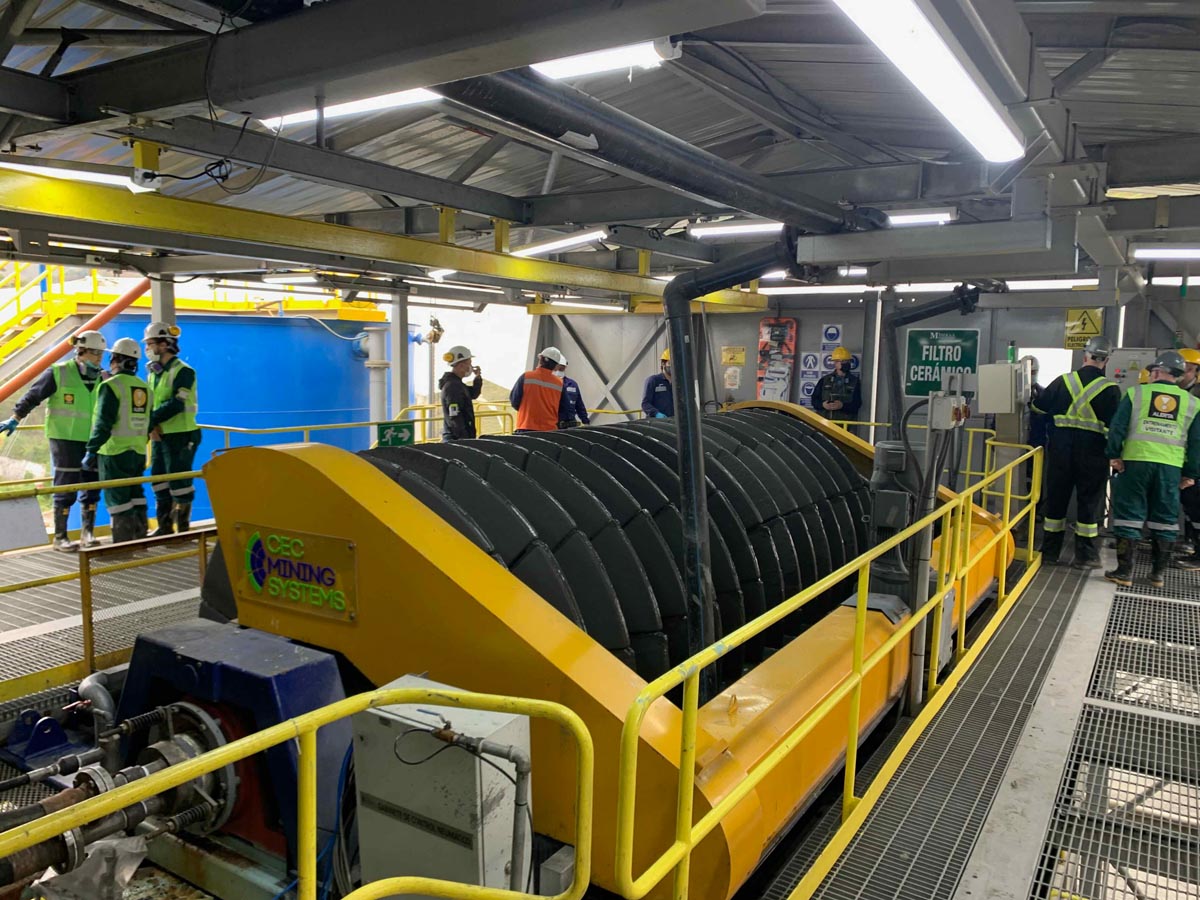
Ceramic vacuum filter equipment uses a microporous alumina ceramic membrane to separate solids from liquids in mining slurries. Unlike traditional vacuum disc filters that rely on woven synthetic filter cloth, this technology employs a rigid ceramic structure with uniform capillary pores. The fundamental principle relies on capillary action, where the microscopic pores allow liquid to pass through while completely blocking air and solid particles. This unique physical characteristic prevents the vacuum loss experienced when cloth filters tear, blind, or degrade over time.
The structural integrity of the ceramic membrane ensures a consistently high vacuum level across the entire filtration area. Because the system only draws liquid through the pores, the vacuum pumps operate at a fraction of the capacity required by cloth-based systems. This translates directly into massive energy savings and a significantly smaller mechanical footprint. The alumina ceramic material is highly resistant to chemical corrosion and mechanical wear, making it ideal for the abrasive and acidic environments found in mineral processing circuits.
Operators benefit from extended campaign lifespans, running continuously for up to 24 months without requiring membrane replacement. This durability eliminates the frequent downtime associated with changing torn filter cloths, ensuring uninterrupted production for tailings dewatering and concentrate filtration applications. The manufacturing process of these advanced ceramic filtration systems involves precise sintering techniques that guarantee strict control over pore distribution, ensuring reliable performance even under varying feed conditions.
How Does Ceramic Disc Filtration Work?
The operational cycle of a ceramic filtration system begins in a slurry basin where the rotary mechanism submerges the ceramic disc segments. As the discs rotate slowly through the basin, a vacuum is applied to the interior of the ceramic segments. This negative pressure, combined with the natural capillary forces of the microporous ceramic membrane, draws the liquid phase of the slurry through the ceramic wall while retaining the solid particles on the outer surface. A filter cake rapidly forms on the exterior of the disc, growing thicker as the segment continues its rotation out of the slurry bath.
Once the segment emerges from the basin, the vacuum continues to pull air through the cake, effectively dewatering the retained solids and lowering the residual moisture content. The filtrate-the liquid that has passed through the membrane-is collected internally and routed to a filtrate tank. Because the ceramic pores are exceptionally fine, ranging from 0.75 to 3.0 microns, the recovered water is virtually free of suspended solids, measuring below 200 ppm. This high clarity allows the filtrate to be returned directly to the plant water circuit without requiring additional polishing or clarification steps.
At the discharge zone, a scraper blade gently removes the dried filter cake from the ceramic surface. A brief backwash cycle using clean water or compressed air is employed to clear any remaining particles from the membrane surface, ensuring the pores remain open for the next rotation. This process ensures a steady output of dewatered solids and recovered water, making the ceramic membrane filter highly reliable for large-scale mining operations. Automated programmable logic controllers adjust the rotational speed based on cake thickness and slurry density to maintain optimal throughput.
Why Choose a Ceramic Vacuum Filter for Tailings?
Tailings management represents one of the most significant environmental and financial liabilities for modern mining companies. Transitioning from conventional wet tailings ponds to filtered dry stacking is a strategic priority, and the ceramic vacuum filter is uniquely suited to support this shift. Dry stacking requires the tailings to be dewatered to a high solids content, creating a stable, geotechnically sound material that is stacked safely without the risk of catastrophic dam failures. The consistent low cake moisture achieved by ceramic disc filtration ensures the stacked material meets strict geotechnical specifications for shear strength and stability.
Beyond safety, the water recovery benefits are significant, especially in arid mining jurisdictions like Chile’s Atacama Desert, Peru, and Western Australia. Filtered tailings reduce site water consumption by up to 85 percent relative to traditional tailings pond disposal (U.S. Environmental Protection Agency, 2024) [4] . Modern ceramic disc filtration systems in mining recover filtrate representing 80 to 90 percent of the water contained in the feed slurry (CEC Mining Systems, 2026) [2] . By maximizing water recovery, mines drastically reduce their reliance on expensive freshwater make-up sources and minimize their environmental footprint. The solid-liquid separation process also eliminates the need for massive, water-retaining tailings storage facilities, freeing up land and reducing long-term closure liabilities. For operations looking to implement Water and Tailings Management , CEC Mining Systems provides practical, cost-effective strategies to support site mass and water balance.
What Are the Energy and Cost Benefits?
The financial justification for upgrading to a ceramic disc filter centers on its dramatic reduction in both capital and operating expenses. Conventional cloth disc vacuum filters require massive vacuum pumps to compensate for the continuous air leakage through the woven fabric and the cake itself. In stark contrast, the microporous ceramic structure only allows liquid to pass, meaning the vacuum system only needs to handle the liquid volume being extracted. Ceramic disc vacuum filtration reduces energy consumption by up to 85 percent compared with conventional cloth disc vacuum filters in mining applications (CEC Mining Systems, 2024) [1] .
To illustrate the scale of these savings, a ceramic vacuum filter with a standard filtration area requires around 15 kilowatts of installed power, whereas a traditional cloth-based system of similar capacity requires up to 170 kilowatts (CEC Mining Systems, 2026) [7] . This nearly 90 percent reduction in installed power translates to massive annual savings in electricity costs, particularly in remote mining operations where power generation is expensive and diesel-reliant. Large ceramic disc filters with about 50 square meters of filtration area consume roughly 365,000 kilowatt-hours per year, which is about 90 percent less than a conventional cloth disc filter of similar duty (CEC Mining Systems, 2026) [7] .
The Process Engineering Team at CEC Mining Systems highlights this advantage, noting the massive power reductions (Process Engineering Team, 2024) [1] . The elimination of filter cloth replacement costs, reduced maintenance labor, and lower flocculant consumption due to superior filtrate clarity contribute to a 30 to 40 percent overall reduction in operating expenses.
Questions from Our Readers
How long does a ceramic membrane last in mining applications?
A ceramic membrane lasts up to 24 months in continuous mining applications before requiring replacement. This extended lifespan is due to the strong alumina construction, which resists mechanical wear and chemical degradation far better than synthetic filter cloths, significantly reducing long-term maintenance costs and operational downtime.
What is the filtrate quality produced by a ceramic vacuum filter?
The filtrate quality contains suspended solids below 200 parts per million, making it exceptionally clean. Because the microporous ceramic structure blocks fine particles and air, the recovered water is clear enough to be pumped directly back into the mineral processing circuit without requiring secondary clarification or polishing steps.
Can ceramic filters handle fine and ultrafine mineral particles?
Ceramic filters effectively capture fine and ultrafine particles due to precise membrane pore sizes ranging from 0.75 to 3.0 microns. This tight pore distribution ensures that even the smallest mineral particulates are retained on the filter cake surface, preventing downstream contamination and ensuring high recovery rates in concentrate filtration circuits.
How does cake moisture compare between ceramic and cloth filters?
Ceramic disc vacuum filters deliver cake moisture between 8 and 12 percent, which is 1.0 to 4.0 percentage points lower than cloth filters. The sustained high vacuum level, unimpeded by air leakage through fabric, extracts more water from the filter cake, resulting in a drier product that is ideal for dry stacking and shipping.
Filtration Technologies Compared
Selecting the right dewatering equipment requires evaluating throughput, moisture targets, and energy profiles. Different technologies serve distinct roles within the mineral processing flowsheet, and understanding their operational differences is important for optimizing plant performance and meeting environmental compliance targets.
| Feature | Ceramic Vacuum Filter | Cloth Disc Filter | Horizontal Belt Filter |
|---|---|---|---|
| Energy Consumption | Up to 85% lower [1] | High (baseline) | Moderate to High |
| Filtrate Clarity | < 200 ppm suspended solids | > 10,000 ppm suspended solids | Moderate (depends on cloth) |
| Filter Media Lifespan | Up to 24 months | Weeks to months | Weeks to months |
| Primary Application | Tailings dry stacking, concentrate | General dewatering | Heavy-duty washing, high capacity |
CEC Mining Systems Filtration Solutions
CEC Mining Systems (CECMS) is a Canadian manufacturer specializing in solid-liquid separation equipment and turn-key tailings dewatering projects. Our flagship CX-Series Ceramic Disc Vacuum Filter uses proprietary microporous alumina technology to deliver unmatched energy efficiency and water recovery for mining operations worldwide. We support clients from the earliest feasibility stages through to commissioning and operational optimization.
Our in-house Bench and Pilot Testing – giving you the data and confidence to power your project from the earliest stages facility in Kamloops, British Columbia, provides rigorous filterability testwork and AI-assisted benchmarking to de-risk your project before capital is committed. Whether you require a single equipment upgrade or comprehensive Engineering Studies, Turnkey and Integrated Plant Supply – save time, reduce costs, and build greater efficiency through full-cycle project execution , our multidisciplinary team ensures your filtration circuit meets site mass balance and sustainability targets. Contact our process engineering team today to evaluate how a ceramic vacuum filter reduces your operating costs and improves tailings management.
Practical Tips for Filter Optimization
Optimizing a ceramic filtration system requires attention to feed conditions, mechanical maintenance, and process monitoring. Implementing best practices ensures the equipment operates at peak efficiency and maximizes the lifespan of the ceramic membranes.
First, ensure consistent feed slurry density and particle size distribution. Fluctuations in solids loading impact cake formation rates and filtrate quality. Installing upstream thickening equipment or using precise flocculant mixing and addition systems helps stabilize the feed, allowing the vacuum filter to operate within its optimal design parameters. Maintain rigorous cleaning protocols for the ceramic membranes. While the alumina surface is highly durable, prolonged exposure to specific mineralogies leads to superficial scaling or pore blinding. Implementing automated ultrasonic cleaning or scheduled chemical washing cycles prevents performance degradation and maintains the high vacuum levels necessary for low cake moisture.
Third, monitor vacuum pump performance and filtrate tank levels continuously. A sudden drop in vacuum pressure or an increase in filtrate turbidity indicates a mechanical seal issue or a damaged ceramic segment. Using remote access and predictive analytics allows operators to identify these anomalies early, scheduling targeted maintenance before a minor issue escalates into unplanned downtime.
Finally, conduct periodic brownfield audits on existing installations. Process conditions and ore bodies change over the life of a mine. Re-evaluating the filtration circuit ensures the equipment configuration still aligns with current production targets and environmental compliance requirements.
Summing Up
The transition toward sustainable mining practices necessitates reliable, high-performance dewatering solutions. A ceramic vacuum filter provides a definitive answer to the dual challenges of energy consumption and water scarcity, delivering measurable improvements in operational efficiency and environmental stewardship. By achieving superior filtrate clarity and significantly lower cake moisture, this technology enables operations to adopt dry stacking and maximize process water recycling.
Upgrading your solid-liquid separation circuit is a strategic investment that yields rapid returns through reduced power costs and minimized consumable usage. To explore how this technology integrates into your specific mineral processing flowsheet, reach out to CEC Mining Systems via our contact form to schedule a technical consultation and request a customized filtration benchmark.
Further Reading
- Ceramic Disc Filtration. CEC Mining Systems.
https://cecminingsystems.com/technologies/ceramic-disc-filtration/ - Mining Filtration. CEC Mining Systems.
https://cecminingsystems.com/mining-filtration/ - Concentrate Filtration. CEC Mining Systems.
https://cecminingsystems.com/concentrate-filtration/ - Rotary Disc Vacuum CEC Mining Systems.
https://cecminingsystems.com/rotary-disc-filter/ - Tailings Filtration: Efficient Water Recovery. CEC Mining Systems.
https://cecminingsystems.com/tailings-filtration/ - Roxia Ceramic Disc Filter – Dewatering Leaflet. Roxia Oy.
https://roxia.com/wp-content/uploads/2022/08/Ceramic-Disc-Filter-Leaflet-Roxia-EN.pdf