Choosing a ceramic filter supplier for tailings or concentrate dewatering? See what to check: testwork, filtrate quality, delivery model, and long-term support.
Quick Summary
A ceramic filter supplier is a company that designs, manufactures, and supports ceramic disc vacuum filters for dewatering tailings and concentrates. A credible supplier publishes filtrate and cake moisture data, tests your material before sizing equipment, and supports the plant after commissioning.
Introduction
Ceramic filter supplier selection decides whether a dewatering circuit runs steadily for years or spends its life in maintenance windows. Mine operators, EPC and EPCM teams, and tailings project owners face the same pressure: tighter tailings regulation, scarce water, and filter cake that must meet moisture targets every shift. CEC Mining Systems Corp. (CECMS), a Canadian manufacturer of solid-liquid separation equipment founded in 2011, supplies ceramic disc vacuum filters and the engineering around them for exactly those problems.
This guide gives a direct answer to the question behind the search. A ceramic disc filter supplier should prove four things: its filtration performance is quantified, its testwork can size your circuit before you buy, its delivery model matches your project, and it stays involved after startup. The four sections below cover what a supplier provides, how to judge the technology, which applications fit, and how testwork and delivery should work. A comparison table and a practical checklist follow. Our view is stated plainly throughout: pick the supplier that tests your material first and publishes numbers you can verify.
What Does a Ceramic Filter Supplier Provide Beyond the Filter?
A ceramic filter supplier is a company that designs, manufactures, and supports ceramic disc vacuum filters and the services around them. The filter is only one line item. A full scope covers material characterization, bench-scale and pilot testwork, equipment sizing, engineering, fabrication, installation support, commissioning, replacement membranes, and operator training.
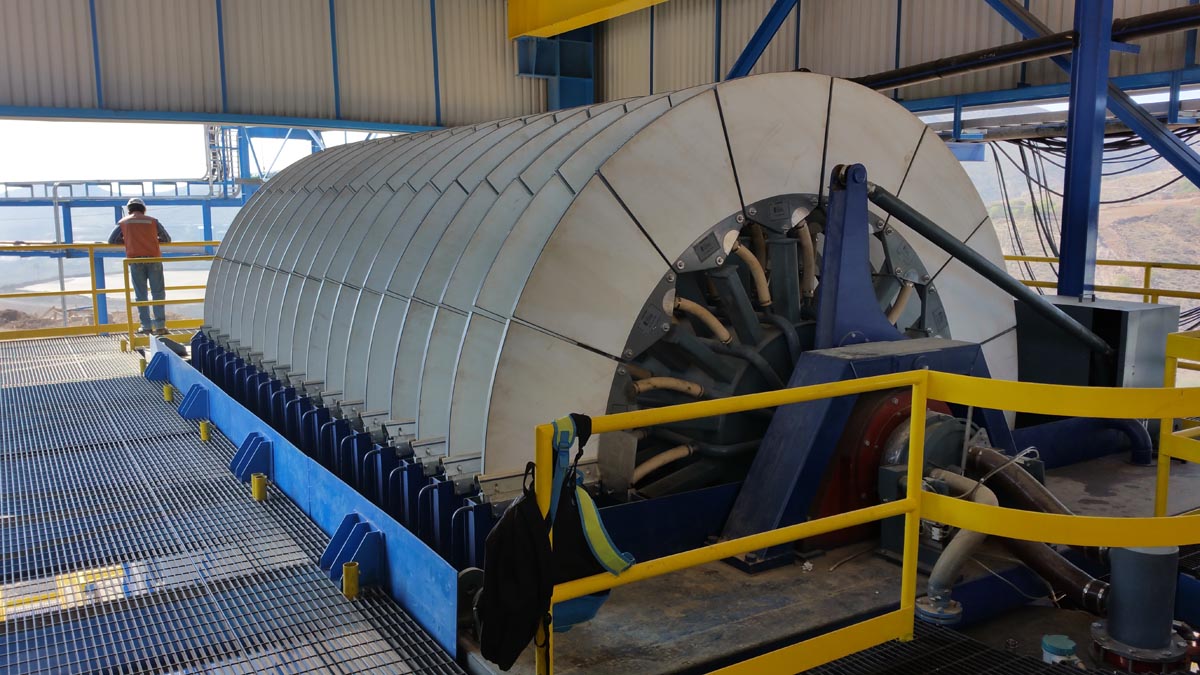
A ceramic disc vacuum filter uses microporous alumina ceramic membranes in place of filter cloth. Rotating ceramic segments pass through a slurry basin, and vacuum and capillary forces draw liquid through the membrane while solids build a cake on its surface. CECMS publishes a membrane pore size range of 0.75 to 3.0 microns for the CX-Series (CEC Mining Systems)[1].
Buyers search under several names: ceramic disc filter supplier, ceramic filtration vendor, ceramic filter manufacturer. The difference that matters is whether the company only builds the machine or also stands behind the process result. A manufacturer sells a filter. A full supplier sells a filtration result backed by testing, engineering, and service.
Mining drives most demand. Main duties include tailings dry stacking, concentrate filtration, and filtration ahead of paste backfill plants, along with industrial water jobs that need fine solids removal. CECMS reports more than 650 systems installed and supported in eight countries (CEC Mining Systems)[2]. We offer that as our own published figure, not an independent benchmark, and you should weigh it the way you weigh any vendor claim.
CECMS lists six services alongside its equipment: bench and pilot scale laboratory testing, brownfield audits and optimization, education and training, engineering studies with turnkey and integrated plant supply, remote access and operational services, and upgrades and rebuilds. When you evaluate a ceramic filter supplier, check how many of those functions sit under one roof and one point of contact, because every handoff between companies adds schedule risk.
Our position is simple. A supplier of ceramic filters that cannot describe its testing, its service model, and its published performance figures in the same conversation is selling hardware, not a dewatering solution.
How Do You Judge a Ceramic Filter Supplier’s Technology?
You judge a ceramic filter supplier’s technology by asking for three numbers: filtrate suspended solids, cake moisture compared with conventional vacuum filtration, and membrane life. If any of the three is missing, the supplier has not finished its engineering. The CX-Series Ceramic Disc Vacuum Filter from CECMS shows what a complete answer looks like.
Filtrate quality and water return
Filtrate quality determines how many fine solids return to your water circuit. CECMS publishes a filtrate suspended solids range of 50 to 200 ppm for the CX-Series, against about 10,000 ppm for conventional vacuum filters (CEC Mining Systems)[1]. Those figures describe solids content only, not water recovery. Cleaner filtrate can go straight back to the circuit, which cuts fines loading and eases the work of clarifiers and thickeners.
Cake moisture and energy
Cake moisture drives stacking behavior, shipping specifications, and paste recipes. CECMS publishes cake moisture 1.0 to 4.0% lower than conventional vacuum filters at similar rates, and up to 85% less energy consumption than conventional methods (CEC Mining Systems)[1]. A drier cake is easier to stack and easier to bring within smelter or transport limits, so request moisture results from your own material instead of relying on a general range.
Membrane life and scale
Membrane life sets your consumables budget. CECMS gives an estimated membrane lifespan of up to 24 months. Treat that as an estimate tied to the slurry and operating conditions, not a guaranteed campaign length, and ask the supplier to state the assumptions behind it. Scale matters too. CECMS project pages publish CX5-50 (50 m²), CX5-80 (80 m²), CX6-120 (120 m²), and CX12-204 (204 m²) models (CEC Mining Systems)[3]. A supplier with a modular range can phase a plant expansion instead of replacing equipment.
Treat any ceramic filter manufacturer’s brochure numbers as a starting point. The number that counts is the one produced by your ore in a bench or pilot test, which is why a supplier’s testing capability belongs in the same evaluation as its hardware.
Where Do Ceramic Filters Fit: Tailings, Concentrate, or Paste Backfill?
Ceramic disc filters fit three main duties: filtered tailings for dry stacking, concentrate filtration, and dewatering ahead of paste backfill. Each duty places different demands on a ceramic filter supplier, so match the supplier’s references to your duty before you compare equipment.
Tailings dry stacking and water balance
Filtered tailings reduce or eliminate the need for a conventional tailings storage facility and return water to the process. Water scarcity and regulatory pressure push operators in Chile, Peru, Mexico, and Western Australia toward this approach. CECMS describes its work on site mass balance and water recovery on its Water and Tailings Management page. A published reference is Aguascalientes, Mexico, where four CX12-204 filters convert tailings storage to in-pit filtered tailings (CEC Mining Systems)[4].
Concentrate filtration
Concentrate filtration needs consistent moisture to satisfy smelter and shipping contracts. CECMS references include CX12-204 units commissioned for iron ore concentrate filtration in eastern Liberia (CEC Mining Systems)[5], and a CX5-50 filter in Zacatecas, Mexico, that replaced a plate-and-frame pressure filter in 2021 (CEC Mining Systems)[6]. Where moisture must fall below what filtration alone reaches, the MIR Steel Belt Dryer is added downstream.
Paste backfill
Paste backfill plants need solid-liquid separation upstream of the paste step. At Tarkwa, Ghana, three CX6-120 filters are listed as operating in 2020 on CIL cyanide detox gold tailings for paste backfill (CEC Mining Systems)[3]. Lower cake moisture reduces filter cake demand in paste applications by allowing more tailings to bypass filtration.
When ceramic is not the right choice
Project pages describe scope and equipment, not cost results, so read these references as evidence of delivery experience, not as performance guarantees. A ceramic filter supplier should also tell you when ceramic is the wrong tool. For heavy washing duties, such as recovering soluble metals like vanadium or lithium or washing cyanide leach discharge, the CX Horizontal Belt Filter is the better match, and CECMS supplies it alongside the ceramic range.
Why Do Testwork and Delivery Model Matter More Than the Quote?
Testwork and delivery model matter more than the quote because filterability varies by ore, and an untested price estimates the wrong thing. A ceramic filter supplier that sizes equipment from a brochure transfers the risk of a wrong guess to you.
CECMS publishes a nine stage process: Project Benchmarking, Bench-Scale Testwork, Conceptual Engineering, Pilot-Plant Testwork, Front-End Engineering, Project Execution and Construction, Operational Readiness, Commissioning, and Operations (CEC Mining Systems)[1]. The sequence works as a yardstick. Whichever supplier you choose should be able to show its own equivalent and tell you which stage produces which deliverable.
Benchmarking at CECMS uses an in-house AI model built on a decade of laboratory and operational data to assess material filterability and predict filtration costs (CEC Mining Systems)[1]. That is a screening tool. Bench and pilot testing at the in-house laboratory in Kamloops, British Columbia, supplies the measured data for equipment sizing, water balance, and cost estimates (CEC Mining Systems)[7].
Delivery model is the second filter. Ask whether the supplier provides equipment only, integrates into an EPC or EPCM scope, or can deliver under a BOOT arrangement. CECMS states that it provides a dedicated contact for comprehensive support from start to finish (CEC Mining Systems)[1]. A single point of contact cuts the coordination load on your owner’s team, particularly on remote sites.
Quality systems belong in the evaluation as well. CECMS describes ISO 9001 Quality Management and ISO 14000 environmental performance certification as achieved on its About Us page (CEC Mining Systems)[2]. ISO 9001 is the international standard for quality management systems. Ask any supplier for the current certificate, its scope, and its issue date, then compare that paper against how the shop actually handles documents, inspection, and traceability.
After startup the relationship continues. Operational readiness work covers HAZID and HAZOP analysis, vendor coordination, and workforce preparation, and CECMS describes a structured support phase for the first hundred days of production. For operating plants, remote monitoring and predictive analytics are offered through its Remote Access and Operational Services program.
Important Questions About ceramic filter supplier
What should I look for in a ceramic filter supplier?
Look for a ceramic filter supplier that publishes filtrate quality and cake moisture data, runs your material through testwork, and supports the plant after commissioning. Ask for filtrate suspended solids, cake moisture, and membrane life assumptions in writing. Confirm that the supplier will test your own material at bench and pilot scale before sizing, and request references that match your duty and filter size. Finally, check the support model: commissioning, operator training, spare membranes, and remote monitoring. Compare answers from at least two suppliers using the same sample and the same questions, so differences in testing quality become visible before you sign a purchase order.
How long does a ceramic filter membrane last?
CECMS publishes an estimated ceramic membrane lifespan of up to 24 months, and actual life depends on the slurry and operating conditions. The membrane is the main consumable in a ceramic disc filter, so replacement interval, cleaning regime, and slurry chemistry all affect cost. Ask the supplier to state its lifespan assumptions and to price replacement membranes in the proposal. Do not accept 24 months as a guaranteed figure, because CECMS describes it as an estimate, and any clause that treats it as a guarantee deserves a question. Bench and pilot data from your own slurry give the most reliable basis for forecasting campaign length.
Is a ceramic filter cheaper to run than a conventional vacuum filter?
Yes, on energy: CECMS publishes up to 85% less energy consumption than conventional methods, and testwork on your material confirms the figure. The CECMS home page also states 30 to 40% lower CapEx and OpEx, but it names no comparator, so treat that as a claim to test in your own evaluation (CEC Mining Systems)[8]. The published 1.0 to 4.0% lower cake moisture and the filtrate quality figures matter as much as energy, because they affect downstream drying, water handling, and stacking costs (CEC Mining Systems)[1]. Ask each supplier for a total cost of ownership comparison built on your own testwork.
Can a ceramic filter supplier deliver a full turnkey plant?
Yes, CECMS offers engineering studies, turnkey, and integrated plant supply, with delivery from conceptual engineering through commissioning and operations. Its service page describes full-cycle project execution that includes front-end engineering, procurement, construction, commissioning, and operational support, with a dedicated contact (CEC Mining Systems)[9]. Equipment-only supply is also possible when an EPC or EPCM firm runs the wider scope. Ask which model suits your owner’s team, how responsibility for performance guarantees is divided between parties, and who coordinates vendors during construction and startup.
Ceramic Filter Supplier Approaches Compared
The three approaches below cover the technologies a mining buyer weighs when requesting proposals from a ceramic filter supplier. The ceramic and belt columns reflect data published by CECMS, and the conventional cloth column is the reference point used on the CECMS ceramic disc page. Use the table as a question list, not as a substitute for testwork on your own material.
| Question for your ceramic filter supplier | Ceramic disc vacuum filter | Conventional cloth vacuum filter | Horizontal belt filter |
|---|---|---|---|
| What is the filtrate quality? | Filtrate suspended solids range from 50 to 200 ppm.[1] | Filtrate suspended solids are about 10,000 ppm.[1] | Filtrate quality depends on the cloth and the duty. |
| What cake moisture can you expect? | Cake moisture is 1.0 to 4.0% lower than conventional vacuum filters at similar rates.[1] | Cake moisture is the reference point for the ceramic comparison. | Cake washing and drying zones are configured to the duty. |
| How much energy does it use? | Energy consumption is up to 85% lower than conventional methods.[1] | Energy consumption is the reference point for that comparison. | Throughput and washing efficiency drive selection more than energy. |
| What is the filter media? | A ceramic membrane has an estimated lifespan of up to 24 months.[1] | Filter cloth is exposed to cloth failures and blinding. | An endless cloth runs on a rubber vacuum belt. |
| Where does it fit best? | It suits tailings dry stacking, concentrate filtration, and paste backfill preparation. | It appears in existing installations being evaluated for replacement or upgrade. | It suits heavy washing, high capacity, and soluble metal recovery. |
How CEC Mining Systems Operates as a Ceramic Filter Supplier
CEC Mining Systems acts as a ceramic filter supplier and a project delivery partner from one Vancouver-based team. Founded in 2011, CECMS supplies the CX-Series ceramic disc filter, the CX Horizontal Belt Filter, the CX Rotaspiral Screen, the MIR Steel Belt Dryer, flocculant mixing and addition systems, thickening and clarifying equipment, and filtration media.
Testing comes first. Our Bench and Pilot Testing service characterizes your material at the CCMR laboratory in Kamloops, British Columbia, so equipment sizing and water balance rest on measured data. Our Engineering Studies, Turnkey and Integrated Plant Supply service then carries the project through engineering, construction, and commissioning with a dedicated contact.
For operating plants, we offer brownfield audits and optimization, upgrades and rebuilds, education and training, and remote access and operational services. We maintain project offices throughout Latin America and work with in-country partners. You can follow company updates on LinkedIn.
Send a sample description or a flowsheet to our team, and we will tell you which technology fits your duty, including when the answer is not a ceramic filter. Call +1 604 685 7823 or email info@cecminingsystems.com to start the conversation.
Practical Tips for Vetting a Ceramic Filter Supplier
A short, evidence-based process keeps a ceramic filter supplier comparison fair. Apply these six checks to every shortlisted vendor.
- Send the same representative sample to each supplier and ask for filterability results in writing before you compare prices.
- Request filtrate suspended solids, cake moisture, and energy figures in a form you attach to the proposal, with the test conditions stated.
- Ask for references that match your duty, whether tailings, concentrate, or paste backfill, and check the filter model size listed for each.
- Clarify membrane life assumptions, cleaning regime, and replacement pricing, and treat any lifespan figure as an estimate unless the contract says otherwise.
- Define the delivery model early: equipment supply, EPC or EPCM integration, or BOOT, and name who holds each performance responsibility.
- Confirm lifecycle support, including operational readiness, operator training, remote monitoring, and upgrade or rebuild options.
Environmental management deserves a question too. CECMS describes ISO 14000 environmental performance certification on its About Us page (CEC Mining Systems)[2], and the ISO environmental management standards set the framework for such systems. Ask each supplier for the certificate itself, then confirm how its design choices, such as clean filtrate return and lower energy use, support your site’s environmental commitments. For brownfield sites, add a plant audit to the process so the new filter is sized for the real circuit, not the original design drawings.
Before You Go
Choosing a ceramic filter supplier comes down to evidence. Look for published filtrate and cake moisture figures, testwork on your own material, references that match your duty and filter size, and a delivery model with a dedicated contact through commissioning and beyond. CECMS offers each of these, and we say plainly that our figures are our own published numbers, to be confirmed in your testwork. If you are weighing a ceramic filter supplier for tailings, concentrate, or paste backfill, send us your sample details. Call +1 604 685 7823, email info@cecminingsystems.com, or write to Suite 460, 688 West Hastings Street, Vancouver, BC V6B 1P1, Canada. Our team will recommend the technology that matches your duty and explain the testwork needed to confirm it.
Sources & Citations
- Ceramic Disc Filtration, CX-Series. CEC Mining Systems.
https://cecminingsystems.com/technologies/ceramic-disc-filtration/ - About Us. CEC Mining Systems.
https://cecminingsystems.com/about-us/ - CIL CN-Detox Gold Tailings Paste Backfill. CEC Mining Systems.
https://cecminingsystems.com/projects/cil-cn-detox-gold-tailings-paste-backfill/ - Projects. CEC Mining Systems.
https://cecminingsystems.com/projects/ - Iron Ore Concentrate Filtration. CEC Mining Systems.
https://cecminingsystems.com/projects/iron-ore-concentrate-filtration/ - Flotation Copper Concentrate Filtration, Zacatecas, Mexico. CEC Mining Systems.
https://cecminingsystems.com/projects/flotation-copper-concentrate-filtration-zacatecas-mexico/ - Bench & Pilot Scale Laboratory Testing. CEC Mining Systems.
https://cecminingsystems.com/services/bench-pilot/ - CEC Mining Systems Home Page. CEC Mining Systems.
https://cecminingsystems.com/ - Engineering Studies, Turnkey & Integrated Plant Supply. CEC Mining Systems.
https://cecminingsystems.com/services/engineering-studies-turnkey-integrated-plant-supply/