Thickening process in mining recovers water and concentrates solids. Learn thickener types, underflow density targets, and optimization steps for tailings.
Key Takeaway
Thickening process in mining is a solid-liquid separation step that concentrates suspended slurry solids into dense underflow while returning clarified water to the process. Thickener selection, flocculant dosing, and underflow density control together determine water recovery, tailings stability, and downstream dewatering or filtration performance.
Thickening Process in Mining in Context
- As of 2026, high-density thickeners for tailings dry stacking achieve underflow solids concentrations of 65–72 percent by mass from feeds at 20–30 percent solids (Reynolds & Bauhm, 2026)[1].
- In an iron ore tailings circuit, a high-rate thickener producing 45–50 weight percent solids underflow recovers about 90 percent of the water entering the thickener (Australian Centre for Geomechanics, 2013)[2].
- Across tailings management strategies, water recovery efficiency increases from 74 percent for conventional tailings to 83 percent for thickened tailings, 89 percent for hybrid tailings, and 93 percent for filtered tailings (MDPI Water, 2022)[3].
- Paste thickeners deliver underflow solids concentrations of 72–78 percent by mass for surface disposal or underground backfill applications (Reynolds & Bauhm, 2026)[1].
Introduction
Thickening process in mining is the first major solid-liquid separation step between grinding and tailings disposal or concentrate handling. It determines how much water returns to the process, how dense the underflow leaves the thickener, and how stable the tailings product remains. CEC Mining Systems Corp. delivers thickening and clarifying equipment and related filtration technologies that integrate with tailings dewatering, paste backfill, and water recovery circuits. The goal is to produce high-density underflow while maximizing overflow clarity and supporting downstream filtration or dry stacking.
This guide explains thickener types, underflow density targets, water recovery performance, and practical optimization steps. It also provides a comparison of high-rate, high-density, paste, and deep cone thickeners plus answers to common questions about mining thickener operation and tailings thickening.
What Is thickening process in mining?
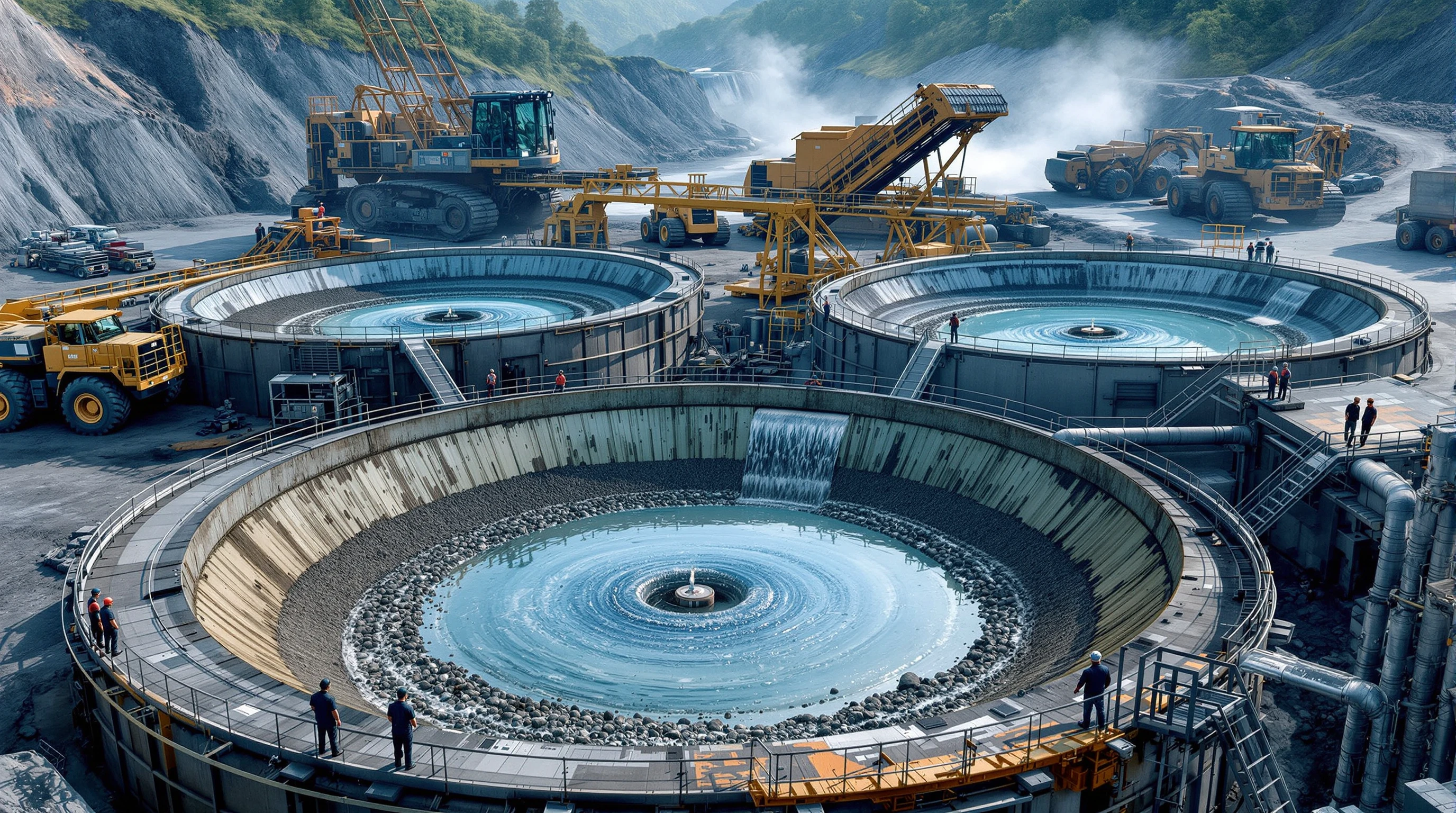
Thickening process in mining is a gravity-based solid-liquid separation operation that increases the solids concentration of slurry to produce clarified overflow and dense underflow. Feed slurry enters a feedwell where flocculant is added, particles aggregate and settle, and a rake mechanism moves the settled solids toward the center discharge. The overflow is reused as process water, while the underflow is sent to tailings storage, dry stacking, paste backfill, or further dewatering.
Continuous thickening reduces the hydraulic load on downstream equipment because less water travels with the solids. It also supports water balance targets in water-constrained mining jurisdictions such as Chile’s Atacama region, Peru’s Andes, and Western Australia. CEC Mining Systems provides thickening and clarifying equipment that maximizes underflow density and overflow clarity in tailings and process water circuits.
The feed solids concentration, particle size distribution, flocculant type, rake torque, and rise rate all affect thickening performance. Rise rate is the upward velocity of clarified water, and solids loading is the mass of solids per unit area per day. Operators control these variables to keep underflow density high and overflow clear.
Operational variables that influence thickening process in mining
Thickener performance is measured by underflow solids percentage by mass, overflow suspended solids, and water recovery. A well-designed thickening circuit returns most of the water contained in the incoming slurry, which reduces freshwater demand and the volume of material sent to tailings storage. The result is a more compact tailings footprint and better operating economics.
How Do Thickener Types Affect thickening process in mining?
Thickener type determines underflow density, rise rate, and water recovery in thickening process in mining. Conventional and high-rate thickeners prioritize throughput and operating cost, while high-density, paste, and deep cone thickeners target dense underflow for tailings dry stacking or backfill.
As of 2026, conventional thickeners produce underflow at 40–50 percent solids by mass, and high-rate thickeners produce 50–60 percent solids by mass from similar feed densities (Reynolds & Bauhm, 2026)[1]. High-density thickeners for tailings dry stacking achieve 65–72 percent solids by mass from feeds at 20–30 percent solids (Reynolds & Bauhm, 2026)[1]. Paste thickeners deliver 72–78 percent solids by mass for surface disposal or underground backfill, and deep cone thickeners reach 75–85 percent solids by mass from feed at 30–40 percent solids (Reynolds & Bauhm, 2026)[1].
Thickener selection depends on the target tailings strategy. A high-rate thickener ahead of a ceramic disc vacuum filter reduces filter feed volume and improves water recovery. For paste backfill, the thickener must produce consistent, pumpable, high-solids underflow that supports binder mixing and backfill strength. In each case, the thickening process in mining sets the hydraulic and rheological conditions for the next unit operation.
Why Does Underflow Density and Flocculation Control Water Recovery?
Underflow density is the most useful control variable in thickening process in mining because it directly signals solid-liquid separation efficiency and water recovery. Flocculation controls how fast particles settle and how much water is retained in the underflow.
As one process engineer explains, “Underflow density, expressed as the percentage of solids by mass in the thickener discharge, is a direct indicator of solid-liquid separation efficiency” (Process Performance evaluation as a tool for thickener modernizations, 2023)[6]. A higher underflow density reduces the water content in the discharged material and decreases the hydraulic load on downstream processes.
A specialist from Rhosonics states, “An increase of 1–2% in underflow density can return large amounts of water to the operating installations” (Rhosonics, 2021)[7]. That water is immediate recycle, not makeup freshwater. According to MDPI Water research, water recovery efficiency increases from 74 percent with conventional tailings to 83 percent with thickened tailings, 89 percent with hybrid tailings, and 93 percent with filtered tailings (MDPI Water, 2022)[3].
Flocculant optimization produces measurable gains. In a mineral sands operation, a flocculant optimization program increased thickener underflow density from 16 percent to 20 percent solids by mass, freeing additional water for recycle (BASF Mining Solutions, 2019)[4]. In tailings thickening samples, solids contents ranged from 49 to 60 percent by mass (University of Oulu, 2024)[5]. These improvements translate directly into water recovery and reduced tailings storage volume.
How Does thickening process in mining Integrate With Tailings Dry Stacking and Paste Backfill?
Thickening process in mining is upstream of tailings dry stacking and paste backfill, and its underflow density determines how much water leaves the tailings stream. Denser underflow reduces tailings storage volume, improves geotechnical stability, and makes downstream filtration or stack placement more efficient.
The Australian Centre for Geomechanics case study reports that an iron ore high-rate thickener produced 45–50 weight percent solids underflow and recovered about 90 percent of the 8,000 cubic meters per hour of water entering the thickener. Adding a paste thickener stage increased overall water recovery to approximately 95 percent of the tailings stream (Australian Centre for Geomechanics, 2013)[2].
For paste backfill, thickening process in mining supplies a consistent, high-solids feed to the paste plant. Lower cake moisture reduces cement demand and improves backfill strength. In water-constrained regions, thickened tailings and filtered tailings strategies recover more process water and reduce reliance on freshwater. CEC Mining Systems supports these circuits with Water and Tailings Management – practical, cost-effective strategies to support site mass and water balance and tailings filtration technology.
When the thickened underflow moves to ceramic disc vacuum filtration, filtrate quality below 200 ppm suspended solids supports direct water reuse. The combination of high-rate thickening followed by ceramic filtration is a proven route to dry stacking and filtered tailings in modern mining operations.
What People Are Asking
What is the thickening process in mining used for?
Thickening process in mining concentrates suspended solids in slurry and recovers clarified water for reuse. It produces dense underflow for tailings storage, dry stacking, paste backfill, or further dewatering, while reducing the volume of water sent downstream. The overflow returns to the process circuit, lowering freshwater demand and improving site water balance.
What underflow density should a mining thickener achieve?
Mining thickener underflow density ranges from 40 percent solids by mass for conventional thickeners to 78 percent for paste thickeners. High-density and deep cone thickeners reach 65–85 percent solids by mass. The target depends on whether the underflow goes to a tailings storage facility, dry stack, paste plant, or filtration circuit.
How does flocculant improve thickening process in mining?
Flocculant aggregates fine particles into larger flocs that settle faster, increasing underflow density and overflow clarity in thickening process in mining. Proper flocculant selection and dosing reduce rise rate, improve solids capture, and return more water to the process. Overdosing hurts settling, so bench and pilot testing is recommended before plant operation.
What types of thickeners are used in mining?
Mining uses conventional, high-rate, high-density, paste, and deep cone thickeners, each producing progressively denser underflow for different tailings and backfill applications. High-rate thickeners suit high-throughput circuits, while high-density and paste thickeners support dry stacking and paste backfill. Deep cone thickeners deliver the densest underflow before mechanical filtration.
Thickener Comparison
Thickener selection changes the solids concentration of underflow and therefore how much water is recovered. The table below compares the main thickener types used in thickening process in mining and shows typical underflow solids, applications, and water recovery context.
| Thickener type for thickening process in mining | Typical underflow solids (% by mass) | Typical application | Water recovery context |
|---|---|---|---|
| Conventional thickener | 40–50 (Reynolds & Bauhm, 2026)[1] | General tailings thickening | Lower underflow density, used as pre-thickening |
| High-rate thickener | 50–60 (Reynolds & Bauhm, 2026)[1] | High-throughput tailings and process circuits | Recovered about 90% of water in an iron ore case (Australian Centre for Geomechanics, 2013)[2] |
| High-density thickener | 65–72 (Reynolds & Bauhm, 2026)[1] | Tailings dry stacking | Denser underflow supports water recovery and stack stability |
| Paste thickener | 72–78 (Reynolds & Bauhm, 2026)[1] | Surface disposal or underground backfill | Supports paste backfill and further reduces tailings water content |
| Deep cone thickener | 75–85 (Reynolds & Bauhm, 2026)[1] | Extreme dewatering and filtered tailings feed | Highest underflow density before mechanical filtration |
CEC Mining Systems and thickening process in mining
CEC Mining Systems Corp. delivers thickening and clarifying equipment plus downstream filtration technology for the thickening process in mining. The company’s solutions support underflow density control, water recovery, and tailings management across mining, metallurgical, and industrial water treatment applications.
In circuits that require filtered tailings, dry stacking, or paste backfill, CECMS pairs thickener performance with the CX-Series Ceramic Disc Vacuum Filter – proprietary ceramic membrane filtration technology for tailings dewatering, concentrate filtration, and paste backfill; 30-40% CapEx/OpEx savings versus conventional technologies. Ceramic disc vacuum filtration captures fine particles while recovering water below 200 ppm suspended solids, which is valuable after thickening.
CECMS also provides Brownfield Audits and Optimization – manage risks before they emerge and identify opportunities to improve filtration performance to upgrade existing thickening and filtration circuits. The company’s bench and pilot testing service uses the CCMR laboratory in Kamloops, BC to generate data for thickener and filter design.
To evaluate thickening process in mining performance or start a tailings dewatering study, contact CEC Mining Systems at +1 604 685 7823 or via the contact form on the company website. We support from bench-scale testwork through commissioning and operational optimization. Follow CEC Mining Systems on LinkedIn for technology updates and project insights.
How to Optimize thickening process in mining in Five Steps
Characterize feed slurry and particle size distribution
Sample the feed stream to measure percent solids, particle size distribution, and slurry rheology. This baseline determines settling behavior and the most appropriate thickener type.
Run bench-scale settling and rheology tests
Use Bench and Pilot Testing – giving you the data and confidence to power your project from the earliest stages to evaluate flocculant types, dosages, and underflow density potential before plant design.
Pilot-test flocculant dosage and feedwell configuration
Optimize flocculant addition to maximize underflow density and overflow clarity. Pilot testing confirms rise rate limits and avoids overdosing, which reduces settling efficiency.
Commission with continuous underflow density monitoring
Install density instrumentation and automate pump control to maintain the target underflow solids range. A stable underflow density protects water recovery and downstream filtration performance.
Integrate downstream dewatering or dry stacking
Route thickened underflow to paste backfill, dry stacking, or ceramic disc vacuum filtration. The upstream thickener performance directly affects the moisture and water recovery of the final tailings product.
The Bottom Line
Thickening process in mining is a foundational solid-liquid separation step that controls water recovery, tailings stability, and downstream dewatering efficiency. Thickener type, flocculant optimization, and underflow density management together determine whether a site achieves thickened, paste, or filtered tailings targets.
CEC Mining Systems supports the full circuit from bench-scale testing through thickening, filtration, and operational support. To start improving water recovery and tailings performance at your operation, contact CEC Mining Systems at +1 604 685 7823 or email info@cecminingsystems.com.
Further Reading
- Mining Tailings Thickening. Reynolds & Bauhm.
https://reynoldsbauhm.co.uk/mining-tailings-thickening - Paste and thickened tailings water benefits – case studies. Australian Centre for Geomechanics.
https://papers.acg.uwa.edu.au/d/1752_43_Johnson/43_Johnson.pdf - Efficient Use of Water in Tailings Management: New Technologies and Environmental Strategies for the Future of Mining. MDPI Water.
https://www.mdpi.com/2073-4441/14/11/1741 - BASF Mining Solutions flocculant case study. BASF.
https://energy-resources.basf.com/dam/jcr:93a56121-3ca3-383a-8647-6626a3937f74/basf/energy-resources/oilfield/case-studies_rheomax/4630_CaseStudy_Rheomax_MineralSands_UE1_6seiter_2019_RZ_ns_low.pdf - Tailings handling methods and water chemistry study. University of Oulu.
https://oulurepo.oulu.fi/bitstream/handle/10024/51479/nbnfioulu-202408165450.pdf - Process Performance evaluation as a tool for thickener modernizations. Perumin.
https://perumin.com/perumin37/public/uploads/shares/programas-doc/foro-tis/salas/Proc_Minerales_%20y_Metal_Extractiva/TT-193%20PM%20ME.pdf - Improve thickener operations by measuring density. Rhosonics.
https://rhosonics.com/insight/blog/improve-thickener-operations-by-measuring-density/