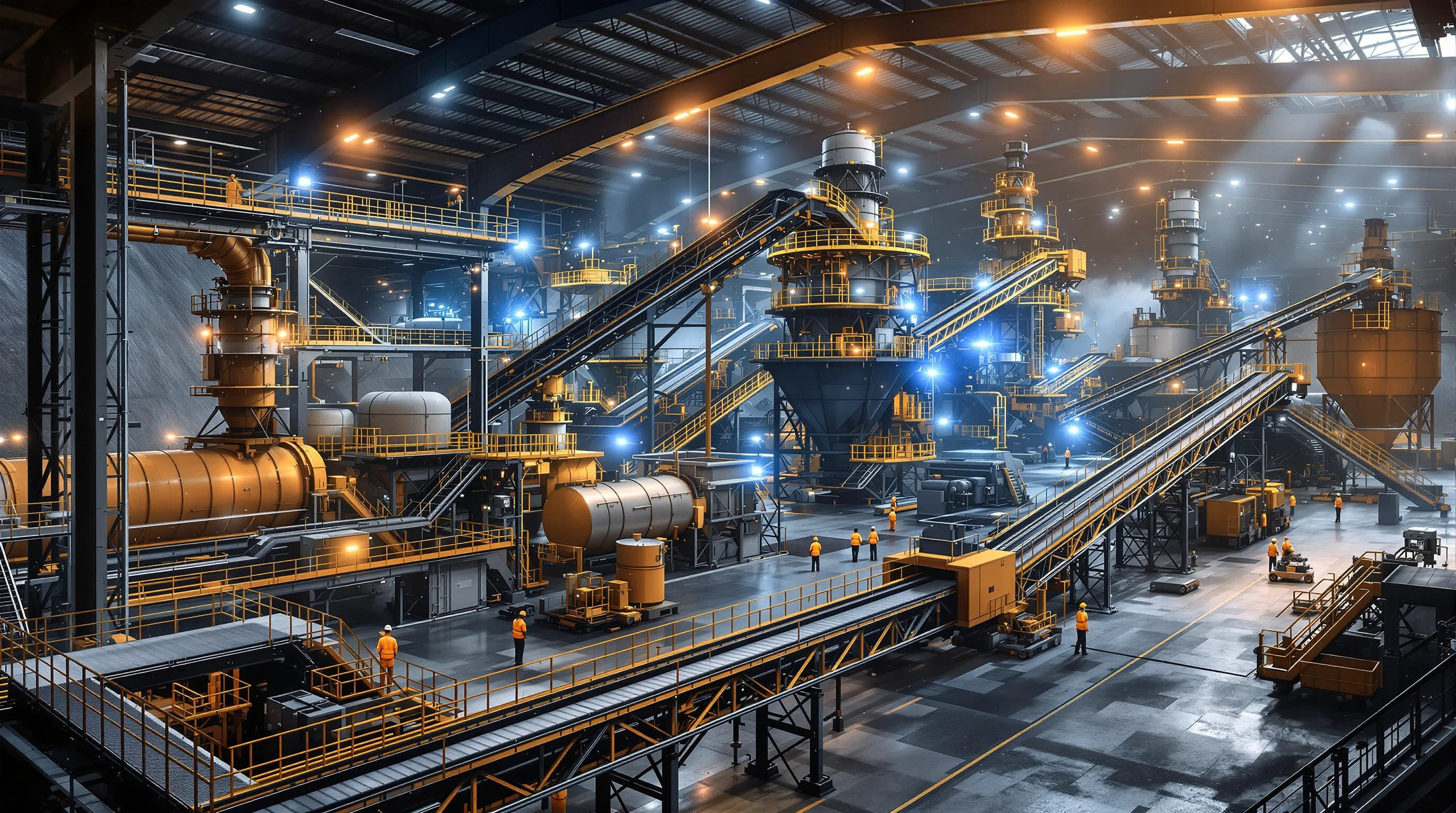
Mineral processing is the important step that turns raw ore into usable materials. This guide covers the core technologies, processes, and efficiency strategies that define modern mineral processing for mining operations.
Article Snapshot
Mineral processing is the systematic treatment of mined ore to separate valuable minerals from waste rock, known as gangue. It involves a sequence of crushing, grinding, and separation stages that transform raw material into a concentrated product ready for metal extraction or industrial use. Companies like CEC Mining Systems provide specialized solid-liquid separation equipment that is essential for efficient water recovery and tailings dewatering in these circuits.
Quick Stats: Mineral Processing
- U.S. mineral processing operations generated approximately $4.6 billion in industry sales in 2024, with an average annual growth rate of 3.5% over the preceding three years (Kentley Insights, 2025)[1].
- The global mineral processing equipment market was valued at $23.37 billion in 2024 and is projected to reach $28.79 billion by 2029, growing at a CAGR of 5.35% (Mordor Intelligence, 2024)[2].
- Canada’s minerals sector, heavily reliant on mineral processing, contributed approximately $159 billion to the nation’s nominal GDP in 2023 (Natural Resources Canada, 2024)[3].
What Is Mineral Processing?
Mineral processing is the industrial sequence of physical and chemical methods used to liberate and concentrate valuable minerals from raw ore. It is a foundational step in the mining value chain, sitting between the mine and metal extraction stages. Without it, the raw rock hauled from a pit or underground would be too lean in target elements to process economically. The Minerals, Metals and Materials Society (TMS) defines it plainly as ‘the art of treating crude ores and mineral products in order to separate the valuable minerals from the waste rock or gangue’ (TMS, 2025)[4]. The goal of mineral processing is to upgrade the ore to a point where downstream smelting or leaching becomes technically feasible and commercially viable.
The field encompasses a series of distinct unit operations, often beginning with crushing and grinding to achieve liberation of target particles. Once the minerals are physically freed from the surrounding rock, separation techniques based on differences in density, magnetic susceptibility, surface chemistry, or size are employed. Finally, the resulting concentrate must be dewatered to reduce its moisture content for safe transport and handling. The final tailings—the leftover slurry of fine particles and water—are managed to recover process water and produce a stable, stackable solid for disposal.
What Are the Core Stages of Mineral Processing?
The core stages of mineral processing break down oversized rock and progressively separate target minerals from waste. The sequence is logical and linear, with each stage preparing the material for the next. While flowsheets can vary widely based on the ore type and the target commodity, most plants follow a broad pattern of comminution, sizing, concentration, and dewatering. A disruption or inefficiency at any single stage will compound through the circuit, undermining the overall recovery and product quality.
Comminution and Sizing
The first stage, comminution, is the physical reduction of raw ore through crushing and grinding. Large run-of-mine rocks are broken down into smaller fragments to liberate the valuable mineral particles from the surrounding gangue. This energy-intensive step is critical for setting up the separation efficiency of everything that follows. Screening devices then sort the ground material by size, ensuring oversized particles are recirculated for further grinding while correctly sized material advances to the concentration circuit.
Concentration and Separation
Once mineral particles are liberated, concentration processes apply physical and chemical properties to separate them. Froth flotation is arguably the most versatile and widely used method, where chemicals make target minerals hydrophobic so they attach to air bubbles and float to the surface. Gravity separation exploits density differences, while magnetic separation pulls out magnetic minerals. Each method produces a high-grade concentrate and a low-grade tailings stream that still contains water and fine waste particles.
Product Dewatering
Dewatering is the final processing stage that strips moisture from the concentrate to meet shipping and smelter specifications and from tailings to create a manageable solid. Solid-liquid separation technologies like thickening and filtration are essential here. The performance of this stage directly affects downstream paste backfill costs, water recovery rates for reuse in the plant, and the environmental footprint of tailings storage. An industry report notes that equipment advances are ‘increasingly focused on energy efficiency, water management, and automation’ to address these priorities (Strategic Market Research, 2026)[5].
Why Is Solid-Liquid Separation Essential in Mineral Processing?
Solid-liquid separation is the operation that removes water from process slurries to recover a dry solid for transport or disposal and clean water for reuse. In mineral processing, it is not a peripheral activity but a core economic and environmental necessity. Without effective dewatering, concentrate exceeds moisture limits for shipping, tailings ponds grow beyond manageable proportions, and plants lose massive volumes of process water that must be replaced from increasingly scarce freshwater sources.
The financial drivers for efficient solid-liquid separation are straightforward. A drier filter cake from a tailings stream reduces the volume and weight of material sent to storage, lowering haulage and dam construction costs. In paste backfill applications, lower cake moisture translates directly into reduced cement binder consumption, a major operating expense for underground mines. On the water side, high-quality filtrate with suspended solids below 200 parts per million (ppm) can be returned to the process circuit immediately, slashing raw water intake requirements and the associated pumping and treatment costs. In water-constrained jurisdictions like Chile’s Atacama region or parts of Western Australia, this water recovery is often the single most important factor in maintaining a site’s license to operate.
Regulatory pressure and sustainability commitments are now tightening standards across the globe. The industry is moving away from conventional slurry tailings ponds toward filtered tailings—dry stacking—which dramatically reduces the risk of catastrophic dam failures and eliminates large standing water bodies. This shift places a premium on filtration technology that can handle high throughputs with reliable continuous operation. The U.S. Geological Survey underscores that the mineral processing industry ‘plays a critical role in transforming raw mineral resources into materials that support infrastructure, energy systems, and advanced manufacturing’ (USGS, 2025)[6], and solid-liquid separation is the gatekeeper technology that determines whether that transformation happens cleanly and efficiently.
How Are Advances in Equipment Driving Mineral Processing Efficiency?
Advances in mineral processing equipment are reshaping what operators can expect from their circuits in terms of energy consumption, water recovery, and uptime. The global market for this equipment, estimated at $23.37 billion in 2024, is growing at a forecasted compound annual growth rate of 5.35% through 2029, with Asia-Pacific alone representing a 67.92% revenue share in 2025 (Mordor Intelligence, 2026)[7]. This growth is fueled not only by rising demand for metals and minerals in construction, energy, and manufacturing but also by the replacement cycle of older, less efficient machinery (Mordor Intelligence, 2024)[2].
The most impactful innovations are concentrated in the dewatering end of the circuit, where filtration technology has seen a measurable leap. Ceramic disc vacuum filters, for example, use microporous membranes rather than conventional filter cloth to achieve significantly lower energy consumption and superior filtrate quality. These systems can deliver filtrate with suspended solids typically between 50 and 200 ppm, compared to over 10,000 ppm for conventional vacuum filters, while using up to 85% less energy. Ceramic disc filtration technology also produces a filter cake that is 1.0 to 4.0% drier than comparable cloth-based methods, a difference that cascades into lower transport costs, reduced binder consumption in paste backfill, and safer, more stable dry stack tailings.
Automation and data integration represent another frontier. Modern plants increasingly deploy sensors and remote monitoring platforms that track filter performance, media health, and water quality in real time. This allows operators to shift from reactive maintenance to predictive analytics, spotting a performance drift before it becomes a production outage. When combined with in-house bench-scale and pilot-plant testwork, these digital tools enable a mining company to benchmark and de-risk a major process change—whether a circuit retrofit or a complete greenfield plant—with a level of confidence that was not possible a decade ago. With 149 companies operating in the U.S. mineral processing industry alone in 2024 (Kentley Insights, 2025)[1], the competitive pressure to adopt these efficiency-driving technologies is intense.
Frequently Asked Questions
What is the primary goal of mineral processing?
The primary goal of mineral processing is to liberate and concentrate valuable minerals from raw ore into a saleable product while separating out waste material. This concentration step radically increases the economic value of the mined material and reduces the mass and volume that must be handled by downstream smelting, refining, or leaching operations. The process turns a resource that is uneconomical to transport and treat directly into a high-grade concentrate.
How does dewatering contribute to sustainable mineral processing?
Dewatering contributes to sustainable mineral processing by recovering clean process water for immediate reuse in the plant, drastically reducing freshwater demand. It also produces a dry, stackable tailings material that eliminates the need for large slurry tailings ponds and the associated risks of dam failure and groundwater seepage. This shift to filtered tailings is a key strategy for securing environmental permits and responding to regulatory pressure in water-scarce mining jurisdictions.
What is the difference between concentrate and tailings in mineral processing?
In mineral processing, concentrate is the high-grade product stream containing a high percentage of the target valuable mineral after separation, while tailings are the remaining slurry of finely ground waste rock, water, and residual chemicals rejected from the process. While concentrate is dewatered for sale or further processing, tailings must be managed and dewatered for safe, stable disposal in a tailings storage facility or through dry stacking.
Why is ceramic disc filtration replacing conventional vacuum filters in mineral processing?
Ceramic disc filtration replaces conventional cloth vacuum filters because its microporous ceramic membrane produces a significantly drier filter cake and higher-quality filtrate at a much lower energy cost. The technology cuts energy consumption by up to 85% compared to conventional methods and delivers filtrate with suspended solids as low as 50 ppm. Operators also gain a 30-40% reduction in capital and operating expenditures over the equipment lifecycle along with continuous operation free from the frequent downtime of cloth changes.
Comparing Solid-Liquid Separation Technologies
Choosing the right solid-liquid separation technology is a decision that impacts energy costs, water recovery, and the viability of tailings management for the life of a mine. The three most common approaches—conventional vacuum filtration, pressure filtration, and ceramic disc vacuum filtration—each occupy a specific niche based on ore characteristics, throughput requirements, and operating cost constraints. The right choice balances upfront capital with long-term operational savings, particularly in energy and filter media replacement. The table below compares these technologies on the metrics that matter most in a production environment.
| Technology | Energy Consumption | Cake Moisture | Filtrate Quality | Media Life |
|---|---|---|---|---|
| Conventional Vacuum Filter | High (baseline) | Higher residual moisture | <10,000 ppm suspended solids | Weeks to months (cloth) |
| Pressure Filter | Very High (hydraulic power pack) | Very low moisture | Low solids | Months (cloths, high-wear) |
| Ceramic Disc Vacuum Filter | Up to 85% lower than conventional[8] | 1.0-4.0% drier than conventional | 50-200 ppm suspended solids | Up to 24 months[9] |
CEC Mining Systems and Mineral Processing Solutions
Founded in 2011 and headquartered in Vancouver, BC, CEC Mining Systems Corp. is a Canadian manufacturer specializing in solid-liquid separation equipment for the global mining industry. Our core focus is delivering ceramic disc vacuum filtration systems and full-cycle turnkey dewatering projects that address the most pressing challenges in modern mineral processing: reducing water consumption, lowering energy costs, and enabling safe tailings dry stacking. With over 650 systems installed across eight countries, we bring deep operational experience to every project, from bench-scale testing to commissioning and long-term support.
Our flagship technology, the CX-Series Ceramic Disc Vacuum Filter, sits at the center of many efficient dewatering circuits. The CX-Series achieves 30-40% lower capital and operating expenditures compared to conventional cloth filters while producing a drier filter cake that reduces downstream paste backfill binder costs. The filtrate, with suspended solids consistently below 200 ppm, returns to the process circuit without additional treatment. Beyond the CX-Series, our horizontal belt filter technology handles heavy-duty washing and high-capacity dewatering for demanding applications. We also provide comprehensive water and tailings management strategies to support site mass balance and environmental compliance from the earliest feasibility stages through the operational life of a plant.
We understand that every ore body is different, which is why our in-house subsidiary, Canadian Critical Minerals Research (CCMR) in Kamloops, BC, conducts bench-scale and pilot-plant testwork on a client’s specific samples. This data provides the foundation for process guarantees and equipment sizing. Our project execution team then delivers through flexible models—equipment supply, EPC, EPCM, or BOOT—ensuring a single point of accountability from concept through commissioning. To help operators maintain peak performance, we also offer remote monitoring and operational services that use predictive analytics to spot issues before they cause downtime. We invite you to discuss your mineral processing challenge with our team at +1 604 685 7823 or through our contact form.
Practical Tips for Optimizing Your Mineral Processing Plant
Optimizing a mineral processing plant requires looking beyond headline recovery numbers to the unit operations that drive energy, water, and media costs. The dewatering circuit, often treated as a utility rather than a profit center, is a particularly high-impact area where small improvements compound into significant savings. The following practical tips target the most common sources of operating cost and downtime in solid-liquid separation, drawing on what we see in brownfield audits and greenfield design.
Start with a thorough material characterization before committing to equipment sizing or process guarantees. Ore characteristics can change over the life of a mine, and filterability testwork on a representative sample is the only way to avoid an undersized or oversized filtration plant. A bench-scale and pilot program that quantifies cake formation rates, moisture targets, and filtrate clarity provides the design basis for an efficient circuit. Without this data, even the best filtration equipment will deliver disappointing results because the design basis is fundamentally disconnected from the material being processed.
Treat water recovery as a key performance indicator on par with metal recovery. The water that a dewatering circuit returns to the process has direct cost value—every cubic meter of recycled filtrate is a cubic meter of water not pumped from a bore field or purchased from a water utility. Track filtrate quality trends daily, and investigate any sustained increase in suspended solids immediately. A slow rise in filtrate turbidity often signals ceramic membrane wear or developing cloth problems well before a catastrophic failure occurs, giving you a window for planned maintenance rather than reactive downtime.
Audit your filter media condition and replacement cycle. For conventional cloth filters, blinding and tearing are major cost drivers that force frequent, unscheduled stoppages. Switching to a ceramic disc technology with a media life of up to 24 months per campaign eliminates those interruptions and the associated labor and lost production. When you factor in the energy savings—a ceramic filter can cut power consumption by 85% compared to a conventional vacuum filter—the operating cost differential over the equipment lifetime becomes the dominant factor in technology selection, often justifying a higher initial capital investment within the first few years of operation.
Wrapping Up
Mineral processing is the engine that converts raw rock into the metals and minerals that build our infrastructure, energy systems, and advanced technologies. Every stage—from comminution and concentration through to final solid-liquid separation—must work in sequence for the operation to be profitable and environmentally compliant. The data is clear: with the global equipment market growing toward nearly $29 billion by 2029 (Mordor Intelligence, 2024)[2] and increasing regulatory focus on water and tailings management, the efficiency of your dewatering circuit is no longer an optional consideration. It is central to your mine’s economic performance and its license to operate.
If you are planning a new mineral processing plant, upgrading an existing filtration circuit, or simply looking to understand what performance benchmarks are achievable with your ore, our team at CEC Mining Systems is ready to help. Contact us at +1 604 685 7823, email info@cecminingsystems.com, or visit our contact page to start a conversation about your project.
Further Reading
- Mineral Processing Operations Market Research Report. Kentley Insights, 2025.
https://www.marketresearch.com/Kentley-Insights-v4035/Mineral-Processing-Operations-Research-Updated-43114108/ - Mineral Processing Equipment Market Size & Share Analysis. Mordor Intelligence, 2024.
https://www.mordorintelligence.com/industry-reports/mineral-processing-equipment-market/market-size - 10 Key Facts on Canada’s Minerals Sector. Natural Resources Canada, 2024.
https://natural-resources.canada.ca/sites/nrcan/files/mapstoolspublications/10_key_facts_mineral_sector_2024_e_NEW_access_Compress.pdf - Mineral Processing Overview. Minerals, Metals and Materials Society (TMS), 2025.
https://www.tms.org - Mineral Processing Equipment Market Report. Strategic Market Research, 2026.
https://www.strategicmarketresearch.com/market-report/mineral-processing-equipment-market - Mineral Commodity Summaries 2025. United States Geological Survey (USGS), 2025.
https://data.usgs.gov/datacatalog/data/USGS:6798fc89d34ea8c18376e8e7 - Mineral Processing Equipment Market Size. Mordor Intelligence, 2026.
https://www.mordorintelligence.com/industry-reports/mineral-processing-equipment-market - CX-Series Ceramic Disc Vacuum Filter. CEC Mining Systems.
https://cecminingsystems.com/technologies/ceramic-disc-filtration/ - Filtration Media. CEC Mining Systems.
https://cecminingsystems.com/technologies/filtration-media/