How does a ceramic filter work in mining? We explain capillary action, vacuum pressure, and the key dewatering benefits today.
Article Snapshot
How does a ceramic filter work? The process is driven by capillary action and vacuum pressure to separate solids from liquids using microporous alumina membranes.
How Does a Ceramic Filter Work in Context
- Ceramic disc vacuum filtration produces filtrate with below 200 ppm suspended solids (CEC Mining Systems, 2026) [1] .
- The technology uses up to 85 percent less energy than traditional vacuum filters (CEC Mining Systems, 2026) [1] .
- Filtered tailings achieve up to 94 percent overall water recovery (CEC Mining Systems, 2026) [1] .
- Vacuum ceramic disk filters process between 200 and 1,500 kilograms per square metre per hour (PORVOO, 2026) [2] .
Introduction
How does a ceramic filter work in modern mineral processing? Mining operations increasingly demand efficient solid-liquid separation to manage tailings and recover water. CEC Mining Systems provides advanced ceramic disc-vacuum filtration systems that address these challenges through superior capillary action and energy efficiency. Understanding the mechanics behind this technology reveals why it outperforms traditional cloth filters in demanding environments. Answering the question, ‘How does a ceramic filter work?’, is central to designing sustainable tailings storage facilities and optimizing concentrate moisture for export. This article explores the working principles, key components, mining applications, and comparative advantages of ceramic membrane separation technology.
What Is the Working Principle of a Ceramic Filter?
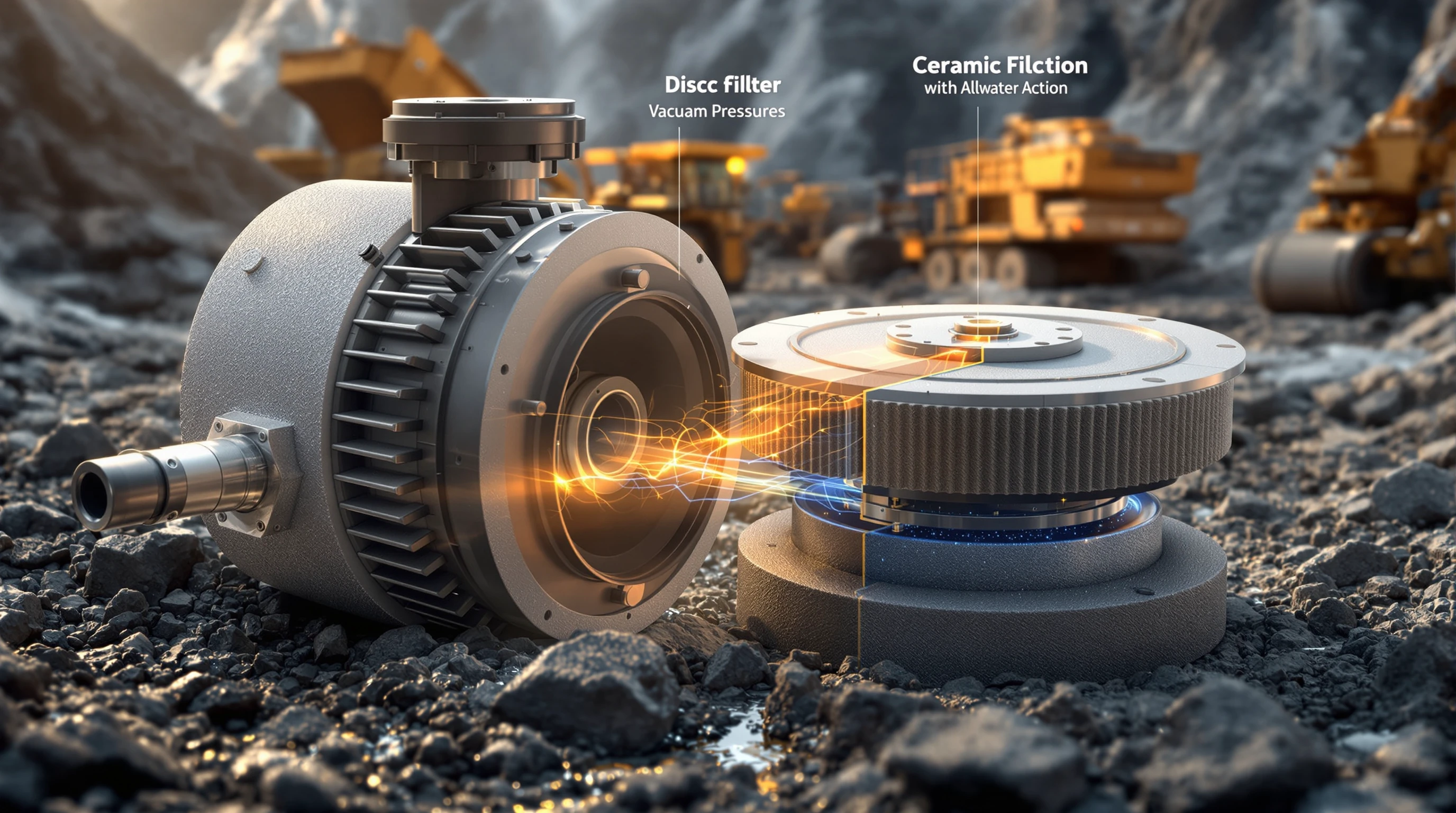
To answer ‘How does a ceramic filter work?’, engineers examine its unique capillary action and vacuum mechanism. A ceramic filter is a solid-liquid separation device that uses microporous alumina membranes and vacuum pressure to extract water from mineral slurries. Unlike conventional filters that rely on woven cloth media, ceramic disc filters use a rigid, microporous structure that fundamentally changes the ceramic filter operation. The core principle relies on capillary forces within the microscopic pores of the alumina ceramic segments. When a vacuum is applied to the interior of the ceramic disc, these capillary forces draw liquid through the membrane while simultaneously blocking solid particles from entering the pores.
This ceramic vacuum filter process creates a highly efficient barrier that prevents air from passing through the membrane, meaning the vacuum pump only needs to extract the liquid phase rather than maintaining a constant air vacuum. This distinction is the primary reason for the massive energy savings associated with ceramic membrane separation. As the ceramic disc rotates through the slurry basin, a filter cake forms on the outer surface of the membrane. The vacuum continues to pull moisture from the cake as it rotates out of the slurry, achieving a remarkably dry solid output. Finally, a discharge mechanism scrapes the filter cake from the ceramic surface, and an automated ultrasonic cleaning cycle flushes the membrane to maintain permeability for the next rotation. This continuous cycle defines the ceramic filter functionality in industrial applications.
How Does a Ceramic Filter Work in Mining Applications?
Ceramic filtration technology serves an important function in modern mining operations, particularly for tailings dewatering and concentrate filtration. The mechanism behind ‘How does a ceramic filter work?’ translates directly to operational benefits like dry stacking and paste backfill preparation. In water-constrained jurisdictions such as Chile, Peru, and Western Australia, mining companies face intense regulatory pressure and physical scarcity regarding freshwater access. Implementing ceramic disc filtration allows these operations to achieve up to 94 percent overall water recovery, changing tailings management from a liability into a sustainable water balance strategy.
For tailings dewatering, the ceramic filter operation produces a dry, stackable filter cake that eliminates the need for traditional, high-risk tailings ponds. This dry stacking approach aligns with the Global Industry Standard on Tailings Management , which mandates safer, more environmentally responsible storage methods. The filtrate recovered during this process contains below 200 ppm suspended solids, making it clean enough to return directly to the mineral processing circuit without requiring additional clarifying steps. This immediate water reuse drastically reduces the make-up water demand from local aquifers or desalination plants.
In concentrate filtration, the ceramic vacuum filter process ensures that metallurgical products meet strict moisture specifications for shipping and smelter contracts. Whether processing copper, zinc, or lithium concentrates, the consistent capillary action of the microporous alumina membranes guarantees a uniform cake moisture level. For underground hard-rock mines using paste backfill, the ceramic filter functionality provides the precise dewatering required to mix tailings with cementitious binders. The drier the filter cake, the less binder is required to achieve the necessary geotechnical strength, resulting in substantial cost savings over the life of the mine. These diverse applications show why the Society for Mining, Metallurgy & Exploration increasingly recognizes ceramic filtration as a standard for modern mineral processing.
What Are the Main Components of a Ceramic Disc Filter?
A complete ceramic disc filter system comprises several integrated components that enable continuous solid-liquid separation. The core element is the ceramic membrane itself, manufactured from microporous alumina with precise pore sizes ranging from 0.75 to 3.0 microns. These membranes are mounted onto ceramic segments that form the large, rotating discs of the filter. The selection of pore size is important to the ceramic filter operation, as it dictates the balance between filtrate clarity and throughput capacity based on the specific particle size distribution of the feed slurry.
The rotating discs are partially submerged in a slurry basin, which is continuously agitated to prevent the settling of heavy solids and ensure a homogeneous feed to the ceramic membrane separation surface. Inside the discs, a network of piping connects the ceramic segments to a central vacuum valve and filtrate tank. This vacuum system is notably smaller than those used in conventional filters because it only needs to move liquid, not air, thanks to the capillary action blocking gas flow through the microporous alumina.
Once the filter cake is discharged by a scraper blade, the system employs an automated cleaning mechanism to maintain the ceramic filter functionality. This process involves an ultrasonic cleaning system combined with a mild acid wash to dissolve any scale or blinding materials that have accumulated within the microscopic pores. This automated regeneration ensures that the ceramic disc filtration mechanism operates continuously without the manual intervention required for cloth replacement. The integration of these components into a single, modular skid allows for scalable deployment in both greenfield projects and brownfield plant upgrades.
Why Does a Ceramic Filter Work Better Than Conventional Filters?
Ceramic disc filters outperform conventional vacuum and belt filters due to their superior energy efficiency, lower operating costs, and consistent filtrate quality. The fundamental reason a ceramic filter works better lies in its elimination of filter cloth, which is a major source of downtime and operational expense in traditional systems. Conventional vacuum filters and belt filter presses require frequent cloth changes due to blinding, tearing, and chemical degradation. The ceramic membrane separation technology completely removes this consumable, offering a membrane lifespan of up to 24 months per campaign.
Energy consumption is another area where the ceramic vacuum filter process shows clear superiority. Because the microporous alumina membranes rely on capillary action that prevents air from passing through the filter cake, the vacuum pumps operate at a fraction of the capacity needed for conventional systems. This mechanical advantage allows ceramic disc vacuum filtration to use up to 85 percent less energy than traditional vacuum filters, significantly reducing the carbon footprint and operating costs of the dewatering plant.
Filtrate quality is equally important in modern mineral processing. Conventional cloth filters allow fine particles to pass through, resulting in filtrate with high suspended solids that requires secondary treatment before reuse. In contrast, understanding ‘How does a ceramic filter work?’ shows it produces filtrate with below 200 ppm suspended solids, ensuring that the recovered water is immediately suitable for process reuse, protecting downstream equipment like heat exchangers and flotation cells from abrasive wear and scaling. For operations evaluating Brownfield Audits and Optimization , switching to ceramic technology resolves chronic bottlenecks associated with poor filtrate clarity and high maintenance downtime, proving that the ceramic filter functionality is a long-term asset rather than a short-term fix.
Important Questions About How Does a Ceramic Filter Work
How does a ceramic filter work without filter cloth?
A ceramic filter operates without cloth by using microporous alumina membranes and capillary action to draw liquid while blocking solid particles. The microscopic pores create a vacuum seal that prevents air from passing through, allowing the system to extract moisture efficiently without the constant degradation and blinding associated with woven textile media. The system eliminates the need for frequent cloth replacements and ensures consistent performance over extended operational campaigns.
How does a ceramic filter work better than conventional filters?
Ceramic filters outperform conventional systems by eliminating cloth downtime, reducing energy consumption by 85 percent, and producing filtrate below 200 ppm suspended solids. The rigid ceramic membrane maintains its structural integrity under vacuum pressure, delivering a drier filter cake and clearer recovered water compared to belt filter presses or traditional rotary vacuum filters. These operational advantages translate directly into lower operating costs and improved sustainability metrics for mining operations.
How does a ceramic filter work for concentrate filtration?
The filter applies vacuum pressure to microporous ceramic segments, extracting moisture from metallurgical concentrates to meet strict shipping and smelter specifications. The uniform capillary action across the ceramic surface ensures consistent cake moisture levels, which is important for preventing product degradation during transport and optimizing smelter feed efficiency. The system handles abrasive mineral slurries effectively, maintaining precise moisture control without the risk of cloth tears that contaminate the final concentrate product.
How often does a ceramic filter work in mining?
Ceramic filters run continuously in mining operations for 24 hours daily, using automated cleaning cycles to maintain membrane permeability and ensure uninterrupted separation. The system is designed for heavy-duty, continuous throughput, processing hundreds of tonnes per hour depending on the filtration area and slurry characteristics. Automated ultrasonic and chemical cleaning cycles occur during the disc rotation, allowing the plant to operate without scheduled downtime for media maintenance or manual washing interventions.
Filtration Technologies Compared
Selecting the right dewatering technology requires comparing the operational mechanics and cost structures of available filtration systems. Mining operations evaluate these approaches based on energy consumption, maintenance requirements, and final cake moisture to determine the most viable solution for their specific mass balance and water recovery targets.
| Technology | Energy Consumption | Filtrate Quality | Maintenance Requirements |
|---|---|---|---|
| Ceramic Disc Filter | Low (up to 85% less) [1] | Excellent (below 200 ppm) [1] | Low (automated cleaning, no cloth) |
| Belt Filter Press | High (continuous air vacuum) | Poor (high suspended solids) | High (frequent cloth replacement) |
| Conventional Vacuum Filter | Moderate to High | Moderate (fines bypass) | Moderate (cloth blinding and wear) |
The data clearly indicates that ceramic disc filtration offers a superior balance of low energy use and high filtrate clarity, making it the preferred choice for operations prioritizing water recovery and operational stability.
CEC Mining Systems Filtration Solutions
CEC Mining Systems specializes in designing and manufacturing advanced solid-liquid separation equipment for the global mining industry. Our flagship CX-Series Ceramic Disc Vacuum Filter uses proprietary microporous alumina technology to deliver measurable CapEx and OpEx savings compared to conventional dewatering methods. We support mining companies, EPC firms, and metallurgical plants with turn-key project delivery, from initial conceptual engineering through commissioning and long-term operational support.
Understanding that every mineralogy is unique, we emphasize the importance of rigorous testwork before scaling to full plant capacity. Our Bench and Pilot Testing services, conducted at our dedicated CCMR laboratory, provide the validated data necessary to size equipment accurately and de-risk your project investment. Whether you are developing a greenfield tailings dry stacking facility or upgrading an existing concentrate filtration circuit, our multidisciplinary team ensures that the ceramic filter functionality is perfectly matched to your site-specific mass balance and environmental compliance requirements.
Practical Tips for Optimizing Ceramic Filtration
Achieving peak performance from a ceramic disc filter requires careful attention to feed preparation, membrane maintenance, and system monitoring. Implementing the following best practices ensures sustained throughput and optimal filtrate quality across the lifespan of the equipment.
- Conduct comprehensive bench-scale testwork to determine the optimal membrane pore size for your specific slurry particle size distribution, ensuring maximum throughput without sacrificing filtrate clarity.
- Implement automated ultrasonic cleaning protocols combined with periodic mild acid washes to prevent scaling and blinding within the microporous alumina structure, maintaining long-term membrane permeability.
- Monitor and control feed slurry density and agitation rates to ensure a homogeneous feed to the filter basin, preventing the settling of coarse particles that cause uneven cake formation and accelerate membrane wear.
- Integrate the filtration system with upstream thickening equipment to stabilize the feed solids concentration, which is important for maintaining consistent filter cake moisture and maximizing overall water recovery in your Water and Tailings Management circuit.
By adhering to these operational guidelines, plant operators fully realize the energy efficiency and low-maintenance advantages inherent in the ceramic filter operation, ensuring reliable performance even in the most demanding mining environments.
Before You Go
Before you go, remember that understanding ‘How does a ceramic filter work?’ is important for optimizing your mineral processing circuit and achieving sustainable water management goals. The technology offers significant advantages in energy reduction, filtrate clarity, and operational continuity that conventional systems simply cannot match. Whether your focus is on tailings dry stacking, paste backfill, or concentrate export, ceramic disc filtration provides a strong, cost-effective solution. Contact CEC Mining Systems today at info@cecminingsystems.com or via our contact form to discuss how our CX-Series technology can improve your solid-liquid separation strategy.
Sources & Citations
- Ceramic Filter Disc Technology. CEC Mining Systems.
https://cecminingsystems.com/ceramic-filter-disc/ - Vacuum Ceramic Disk Filter Throughput vs Belt Filter. PORVOO.
https://porvoo.com.cn/blog/vacuum-ceramic-disk-filter-throughput-vs-belt-filter-real-world-capacity-data-from-12-mining-operations/