A belt filter press is a continuous mechanical dewatering technology that squeezes conditioned sludge between porous belts to produce a high‑solids cake, reducing volume and disposal costs for municipal and industrial wastewater treatment plants.
Key Takeaway
Belt filter press is a continuous sludge dewatering machine that uses graduated pressure and porous belts to turn liquid sludge into a handleable cake. By reducing water content, it cuts transportation and disposal costs while enabling compliance with environmental regulations.
Belt Filter Press in Context
- A continuous belt filter press can produce a 30% solids cake with polymer conditioning (U.S. Environmental Protection Agency, 2021)[1].
- For primary sludge, typical belt filter press cake dry solids are about 30%, with an operational range of 26–35% (The MBR Site, 2025)[2].
- The U.S. sludge dewatering system market is valued at US$0.75 billion in 2025 and is projected to reach US$1.204 billion by 2032 (MarkNtel Advisors, 2025)[3].
- The belt filter press segment of the global sludge dewatering equipment market is projected to grow from US$856.90 million in 2025 to US$2,083.29 million by 2034, at a 10.2% CAGR (Industry Research Biz, 2025)[4].
How Does a Belt Filter Press Work?
A belt filter press works by feeding chemically conditioned sludge onto a moving porous belt, then progressively squeezing it between two tensioned belts to force out water and produce a dry, solid cake. This continuous mechanical dewatering process has been refined over decades and remains a cornerstone of sludge management at wastewater treatment plants worldwide. According to the United States Environmental Protection Agency, dewatering wastewater solids with equipment like a belt filter press “reduces the volume of residuals, improves operation, and reduces costs for subsequent storage, processing, transfer, end use, or disposal” (U.S. Environmental Protection Agency, 2025)[5].
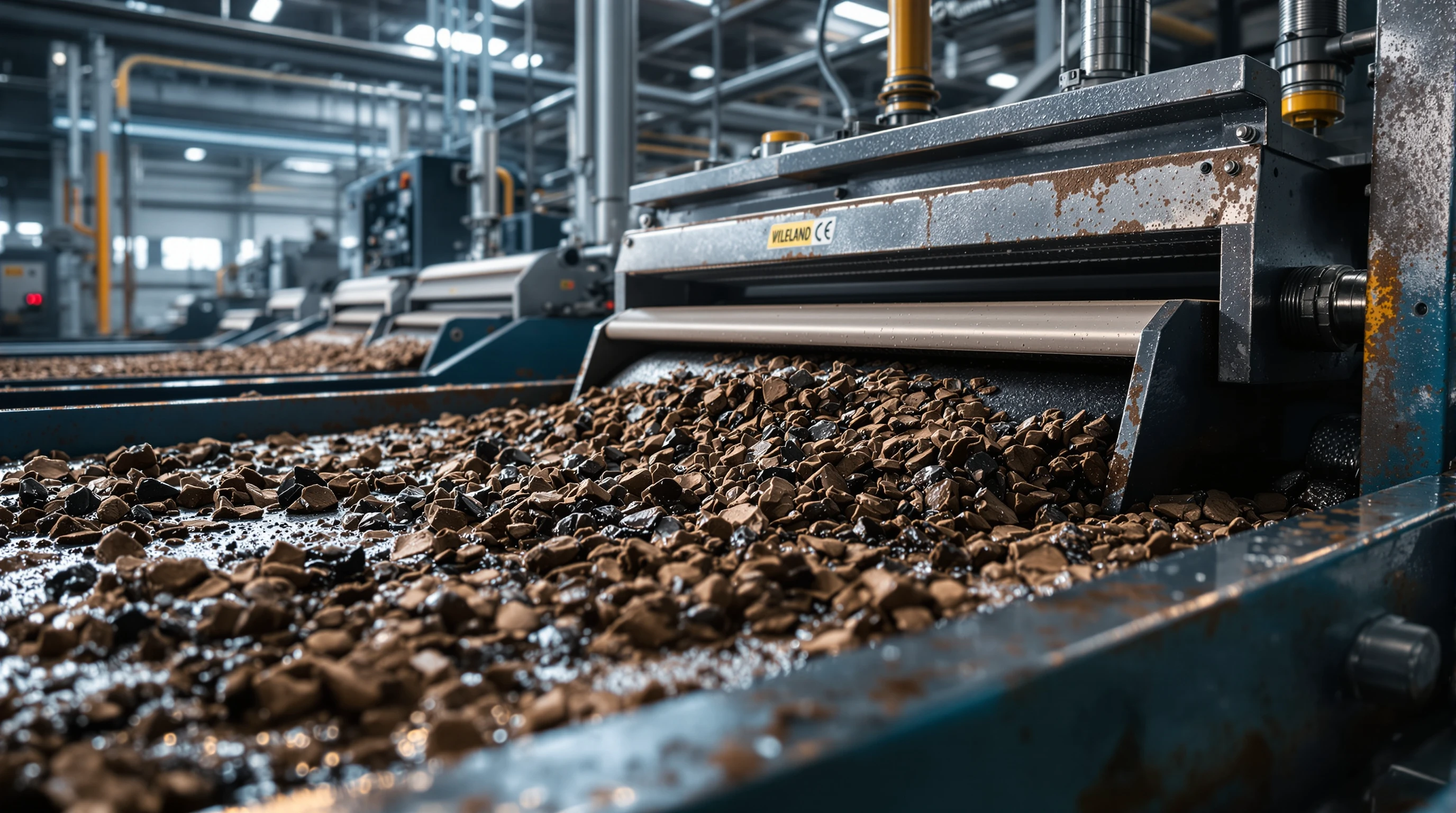
The operation of any belt filter press breaks down into three distinct zones. First, the gravity drainage zone allows free water to drain through a porous belt under its own weight, raising the solids concentration from 1–6% to roughly 8–15%. Next comes the wedge or medium‑pressure zone, where the sludge is captured between an upper and lower belt and gently compressed as the belts converge. Finally, in the high‑pressure shear zone, the belts snake around a series of rollers of decreasing diameter, applying increasing pressure and a shearing action that releases additional bound water. The result is a consolidated cake that can be conveyed, stacked, or landfilled with minimal liquid handling.
Polymer conditioning is at the heart of the belt filter press process. Before reaching the belt filter press, a dilute polymer solution is injected into the sludge stream to flocculate fine particles. Proper polymer mixing is essential: under‑dosed sludge will blind the belts and produce a wet cake, while over‑dosing wastes chemicals and can cause the cake to stick to the belts. Belt filter press operators adjust polymer dosage in real time based on visual observation and on‑line solids monitoring, aiming for a floc that is firm enough to hold water in the gravity zone yet release it under pressure.
Belt tension, alignment, and wash water are equally important. The belts – usually woven polyester or polypropylene monofilament – must be kept clean with high‑pressure spray bars to maintain porosity. If blinding occurs, cake discharge becomes uneven and throughput drops. Regular inspection of bearings, rollers, and pneumatic systems helps sustain the belt filter press at design capacity, which in municipal applications handles 300–500 dry pounds per meter of belt width per hour.
Applications and Sludge Types for Belt Filter Presses
Wherever wastewater treatment generates organic or inorganic sludge, a belt filter press is a proven choice for volume reduction. Municipal plants are its largest market, but industrial facilities such as pulp and paper mills, food processors, and chemical plants also rely on belt filter press dewatering to meet discharge standards and control disposal costs. The technology handles a wide variety of feed sludges, including primary sludge, waste activated sludge (WAS), anaerobically and aerobically digested biosolids, and blended streams.
In a municipal wastewater plant, primary sludge – which settles out in primary clarifiers – is highly amenable to belt filter press dewatering. Because it consists largely of inorganic grit, paper fiber, and settleable organics, primary sludge releases water readily. The MBR Site notes that belt filter presses producing a cake having a dry solids content of 30 percent or more in the case of primary sludge (The MBR Site, 2025)[6]. Waste activated sludge, which is predominantly bacterial biomass, is more difficult to dewater; a belt filter press yields a cake of about 16% dry solids, with a range from 12% to 20% (The MBR Site, 2025)[2]. When primary and waste activated sludge are blended – a 50:50 mixture is common at many plants – the cake solids fall between 18% and 23% (U.S. Environmental Protection Agency, 2000)[7].
The feed solids concentration heavily influences throughput. The U.S. Environmental Protection Agency reports that belt filter presses dewater sludge with feed solids between 2.4% and 10%, achieving a final cake of at least 30% solids under optimal conditioning (U.S. Environmental Protection Agency, 2021)[1]. If the incoming sludge is too thin, the gravity zone becomes overloaded and filtrate quality suffers; if it is too thick, mixing with polymer is uneven and belt life shortens.
Industrial sludges bring specific challenges. Pulp and paper sludge, for example, contains long fibers that blind belts, while oily or greasy sludges from food processing coat belt surfaces and reduce drainage. In such cases, careful polymer selection and possibly a pre‑screening step are required. Nevertheless, the fundamental principle holds: a belt filter press delivers reliable, continuous dewatering for nearly any sludge with initial solids of 1–6%, yielding a final cake in the 12–50% dry solids range depending on sludge type and conditioning (U.S. Department of Defense, 1999)[8].
Performance Ranges and Key Operating Parameters
Understanding what a belt filter press achieves in practice requires looking at actual performance data rather than idealized design figures. Cake dry solids – the percent weight of solids in the discharged cake – is the primary metric, but throughput, solids capture efficiency, and polymer consumption are equally important for plant budgets.
For primary sludge, a belt filter press produces cake solids of 26–35%, with a value of 30% (The MBR Site, 2025)[2]. Waste activated sludge alone yields 12–20%, while a blended primary‑WAS mixture falls in the 15–25% range. Anaerobically digested primary sludge, fed at 2–5% solids, is dewatered to 24–35% cake dry solids in laboratory simulations (The MBR Site, 2025)[2]. These numbers show that the belt filter press is versatile but that each sludge stream must be evaluated individually. Bench‑scale testing – such as the service offered by CEC Mining Systems’ bench and pilot program – provides the data needed to calibrate belt filter press sizing and polymer dosing for unique slurries.
Hydraulic throughput is expressed as gallons per minute per meter of belt width (gpm/m). A municipal belt filter press processing a 2–3% feed sludge handles 30–60 gpm/m, while a thicker 5–6% feed allows 80–120 gpm/m. The delivered cake solids and throughput are inversely related: pushing too much sludge onto the belts lowers residence time in the gravity zone and results in a wetter cake. Experienced operators balance these variables by adjusting belt speed, polymer injection rate, and feed concentration.
Solids capture – the percentage of incoming solids that end up in the cake rather than escaping in the filtrate – exceeds 95% in well‑operated belt filter presses. Low capture means solids return to the plant headworks, increasing both organic loading and polymer consumption. Filtrate from the belt filter press is recycled to the plant inlet, so high capture is important for stable biological treatment.
From an economic perspective, the U.S. sludge dewatering system market, valued at US$0.75 billion in 2025, is forecast to reach US$1.204 billion by 2032, and the belt filter press segment alone is expected to grow from US$856.90 million in 2025 to US$2.08 billion by 2034 at a compound annual growth rate of 10.2% (Industry Research Biz, 2025)[4].
Advantages and Limitations of Belt Filter Press Dewatering
Choosing a belt filter press over another dewatering technology is a decision that balances capital cost, operating labor, and cake quality. The belt filter press offers several practical advantages. It runs continuously, which suits plants that generate sludge around the clock. Its energy consumption is modest compared to centrifuges – only the belt drive motors and wash water pump run continuously – and its mechanical components are accessible for in‑house maintenance crews. Because the belt filter press does not rely on high‑speed rotation, vibration and noise levels are low, contributing to a better operator environment.
Another key benefit is low polymer consumption relative to other dewatering methods. With proper conditioning, a belt filter press achieves high capture with minimal chemical use. And because the cake is discharged continuously as a sheet or crumb, it is easy to convey into trucks or storage without intermediate handling.
However, the belt filter press also has limitations that must be weighed during the selection process. Its footprint is larger than that of a centrifuge of comparable throughput. The belts require a reliable, high‑pressure wash water supply, and if that supply is interrupted, the belts quickly blind. Odor is another concern: the open construction of a belt filter press releases volatile compounds into the air, so indoor installations must be paired with adequate ventilation and odor control systems. Sludges containing abrasives – such as grit or sand – accelerate belt wear and increase maintenance costs.
Compared to a chamber filter press, a belt filter press yields a lower cake solids (30% vs. 35–45% for the same sludge), meaning the cake is heavier to transport and does not meet landfill acceptance criteria without further drying. On the other hand, the belt filter press’s continuous operation and lower labor requirement make it the preferred choice for larger municipal plants where consistent medium‑dry cake is acceptable. For final moisture specs that cannot be reached by mechanical pressure alone, thermal drying – for instance, a steel belt dryer that combines vacuum filtration with infrared radiation – is integrated downstream, a solution CEC Mining Systems offers for concentrate drying in mineral processing.
Your Most Common Questions
What is a belt filter press?
A belt filter press is a continuous mechanical dewatering device that forces conditioned sludge between two tensioned porous belts, squeezing out water to produce a solid cake suitable for transportation or disposal.
The belt filter press feeds chemically conditioned sludge onto a gravity drainage zone, then captures it between an upper and lower belt in a wedge zone, and finally subjects it to increasing pressure around a series of rollers. The resulting cake contains 15–30% dry solids, depending on the sludge type and conditioning.
How much does a belt filter press cost?
The capital cost of a belt filter press depends on belt width, materials of construction, and ancillary equipment such as polymer make‑down systems, with small municipal units starting around US$100,000 and large industrial systems exceeding US$500,000.
Operating costs are dominated by polymer (US$15–45 per dry ton of solids) and electricity (under 20 kW for a medium‑sized press). Because the belt filter press is continuous and largely automated, labor requirements are low – one operator per shift for multiple units. Overall lifecycle cost compares favorably with centrifuges, particularly for sludges that are easily dewatered.
What is the typical belt filter press cake solids?
Belt filter press cake solids range from 15% to 35% dry solids, varying by sludge type: primary sludge yields 26–35%, waste activated sludge 12–20%, and blended primary‑WAS sludge 15–25%.
With optimal polymer conditioning and belt tension, a continuous belt press produces a cake of 30% solids or more on primary sludge. The final concentration depends on the ratio of volatile to fixed solids, floc strength, and the applied pressure in the shear zone. Bench testing provides the most accurate forecast for a particular plant’s sludge.
How does polymer conditioning affect belt filter press performance?
Polymer conditioning flocculates fine sludge particles into larger, drainable aggregates, directly determining the belt filter press’s cake solids, solids capture, and throughput; under‑dosing causes belt blinding and wet cake, while over‑dosing wastes money and makes the cake sticky.
The right polymer type for a belt filter press – a high‑molecular‑weight cationic polyacrylamide for municipal sludge – and dosage are found through jar testing and on‑site trials. Once established, polymer consumption runs 8–18 pounds of active polymer per dry ton of solids. Continuous monitoring allows operators to trim the dose as sludge characteristics change, achieving payback on polymer optimization within months.
Comparing Belt Filter Press to Other Dewatering Technologies
Selecting the right dewatering equipment means matching the technology to sludge characteristics, cake requirements, and operating context. The table below contrasts the belt filter press with the centrifuge, the chamber filter press, and the rotary vacuum filter, four mainstream options. Performance numbers for the belt filter press are drawn from the U.S. Environmental Protection Agency and The MBR Site data cited in this article; other figures are industry‑accepted ranges.
| Technology | Cake Dry Solids (Primary Sludge) | Energy Consumption | Labor Intensity | Advantages | Limitations |
|---|---|---|---|---|---|
| Belt Filter Press | 26–35% | Low (belt drives + wash water) | Low‑moderate | Continuous, low polymer, simple maintenance | Open tank (odor), larger footprint, lower cake than filter press |
| Centrifuge | 25–35% | High (high‑speed motor) | Low | Compact, enclosed, high throughput | High power and polymer demand, wear from abrasives |
| Chamber Filter Press | 35–45%+ | Low | High (batch operation) | Driest cake, very high capture | Batch, labor‑intensive, large footprint |
| Rotary Vacuum Filter | 22–30% | Moderate (vacuum pump) | Moderate | Suitably for fibrous sludges, continuous | Lower cake solids, cloth blinding, maintenance of vacuum system |
In municipal settings where 30% cake is sufficient for landfilling or composting, the belt filter press wins on total cost of ownership. When a drier cake is required – for incineration or long‑distance hauling – a chamber filter press or a centrifuge followed by a dryer is indicated. In mining and mineral processing, where large volumes of tailings must be dewatered for dry stacking or paste backfill, the horizontal belt filter emerges as a strong alternative, offering heavy‑duty construction and high throughput. CEC Mining Systems supplies such horizontal belt filters alongside its ceramic disc vacuum technology, enabling mining operations to select the best fit for their specific dewatering challenge.
CEC Mining Systems and Belt Filter Press Solutions for Mining
While the municipal belt filter press dominates the wastewater sector, the same mechanical principle – squeezing a conditioned slurry between porous belts – scales into the mining industry through heavy‑duty horizontal belt filters. CEC Mining Systems Corp. has been delivering solid‑liquid separation solutions since 2011, with over 650 systems installed across eight countries, and its horizontal belt filter is engineered for the demanding dewatering and washing applications found in mineral processing and tailings management.
CEC Mining Systems’ horizontal belt filter is built for high‑capacity continuous operation, handling abrasive slurries and delivering consistent cake discharge with effective counter‑current washing. In copper, gold, and phosphate concentrators, the horizontal belt filter dewaters concentrates to meet shipping moisture specifications, while in tailings plants it supports water recovery and reduces tailings storage volume. For mining companies that need to dewater fine tailings for dry stacking or paste backfill, CEC Mining Systems provides the CX‑Series Ceramic Disc Vacuum Filter, which achieves 30–40% lower capital and operating costs than conventional vacuum filters and produces filtrate with suspended solids below 200 ppm.
Unlike large OEMs, CEC Mining Systems offers a single‑point‑of‑contact project approach. From bench and pilot testwork at its CCMR subsidiary in Kamloops, BC through process design, procurement, construction, and commissioning, CEC Mining Systems integrates the right filtration technology – belt filter, ceramic disc, or a combination – to achieve the project’s water balance and cake quality targets. CEC Mining Systems’ turnkey and integrated plant supply model means one team handles every phase, reducing interface risk and accelerating startup.
Whether you manage a municipal biosolids program or a multi‑million‑tonne tailings facility, the core dewatering principle is the same: squeeze out water to reduce volume and recover a reusable resource. CEC Mining Systems brings a decade of specialized solid‑liquid separation experience to your project. Contact CEC Mining Systems’ team or use its solution finder to start the conversation about your dewatering needs.
Practical Tips for Optimizing Belt Filter Press Performance
Getting the most from a belt filter press day in and day out requires attention to a handful of operational details. The following tips reflect best practices drawn from plants that consistently achieve high cake solids and low polymer consumption.
First, polymer mixing and aging matter. Use a high‑energy, two‑stage polymer make‑down unit and allow a minimum 30‑minute aging time for the solution to fully hydrate. Inject the polymer as close to the press inlet as practical, and consider a post‑injection static mixer to distribute it evenly. Monitor floc size and strength visually; a firm, small‑to‑medium floc (2‑4 mm) that holds its shape in a bucket test signals good conditioning.
Second, manage belt wash water relentlessly. Wash‑water pressure should be maintained at 80–120 psi with a flow rate of 20–40 gpm per meter of belt width. Use filtered, solids‑free water to avoid nozzle plugging. Inspect spray patterns daily – even one clogged nozzle starts a cascade of belt blinding. If the belt appears dry or shiny after washing, increase pressure or add a belt cleaning agent.
Third, track belt tension and alignment. Most belt filter presses have pneumatic tensioning; set the pressure according to the manufacturer’s curve for the belt type and width. Periodically check belt tracking using a straightedge and adjust steering pneumatics to prevent edge wear. Replace belts when the seam shows thinning or the fabric becomes so embedded with solids that wash‑water treatment cannot restore porosity.
Finally, maintain a data log. Record feed rate, belt speed, polymer dose, cake solids, and wash‑water conditions every shift. Over time, this log reveals the relationship between operating parameters and cake quality, enabling predictive adjustments rather than reactive firefighting. If performance drifts, a brownfield audit can identify root causes – whether that is a change in sludge characteristics, mechanical wear, or an underperforming polymer – and restore the belt filter press to its design envelope.
Key Takeaways
The belt filter press remains one of the most cost‑effective continuous dewatering technologies for municipal and industrial sludge. It delivers cake solids between 15% and 35%, depending on sludge type, with modest energy and polymer consumption. The U.S. market alone is projected to exceed US$1.2 billion by 2032, confirming that the belt filter press continues to evolve and attract investment.
Choosing and operating a belt filter press successfully depends on matching the equipment to the sludge, fine‑tuning polymer conditioning, and maintaining belts and wash‑water systems. For industries beyond municipal wastewater – mining, metallurgical refining, and tailings management – the same belt‑press principle is embodied in heavy‑duty horizontal belt filters, such as those supplied by CEC Mining Systems. With turnkey project delivery and in‑house testwork, CECMS helps clients dewater slurries efficiently, recover water, and reduce environmental liability.
To discuss how a belt filter press or a custom solid‑liquid separation solution lowers your operating costs, contact CEC Mining Systems or call +1 604 685 7823 today.
Sources & Citations
- Evaluation of Dewatering Devices for Producing High‑solids Sludge Cakes. U.S. Environmental Protection Agency.
https://nepis.epa.gov/Exe/ZyPURL.cgi?Dockey=20006EIY.TXT - Belt filter presses for sludge dewatering. The MBR Site.
https://www.thembrsite.com/belt-filter-presses-sludge-dewatering - The US Sludge Dewatering System Market Study. MarkNtel Advisors.
https://www.marknteladvisors.com/research-library/the-us-sludge-dewatering-system-market-study.html - Sludge Dewatering Equipment Market Report. Industry Research Biz.
https://www.industryresearch.biz/market-reports/sludge-dewatering-equipment-market-102374 - Fact Sheet: Belt Filter Press. U.S. Environmental Protection Agency.
https://www.epa.gov/biosolids/fact-sheet-belt-filter-press - Belt filter presses for sludge dewatering. The MBR Site.
https://www.thembrsite.com/belt-filter-presses-sludge-dewatering - Design Manual: Dewatering Municipal Wastewater Sludges. U.S. Environmental Protection Agency.
https://nepis.epa.gov/Exe/ZyPURL.cgi?Dockey=20008QGY.TXT - Predicting the Performance of Belt Filter Presses Using the Crown Press for Laboratory Simulation. U.S. Department of Defense.
https://apps.dtic.mil/sti/tr/pdf/ADA366382.pdf