Paste backfill is an engineered mine backfill material made from dewatered tailings and binder. Learn how paste backfill works, its benefits, and the role of ceramic disc filtration in underground mining operations.
Article Snapshot
Paste backfill is an engineered mixture of dewatered mine tailings and a small proportion of binder, usually cement, that forms a thick, non-segregating paste transported through pipelines to fill underground mined-out voids. It provides ground support, enables higher ore recovery, and significantly reduces environmental footprint compared to conventional tailings storage.
By the Numbers
- Paste backfill water recovery surpassed 95 percent in an iron mine case study (University of Western Australia, 2017)[1].
- The global mine backfill services market is projected at US$5.1 billion in 2026 (Persistence Market Research, 2026)[2].
- This market is forecast to reach US$8.6 billion by 2033 (Persistence Market Research, 2026)[2].
- A compound annual growth rate of 7.8 percent is expected from 2026 to 2033 (Persistence Market Research, 2026)[2].
What Is Paste Backfill?
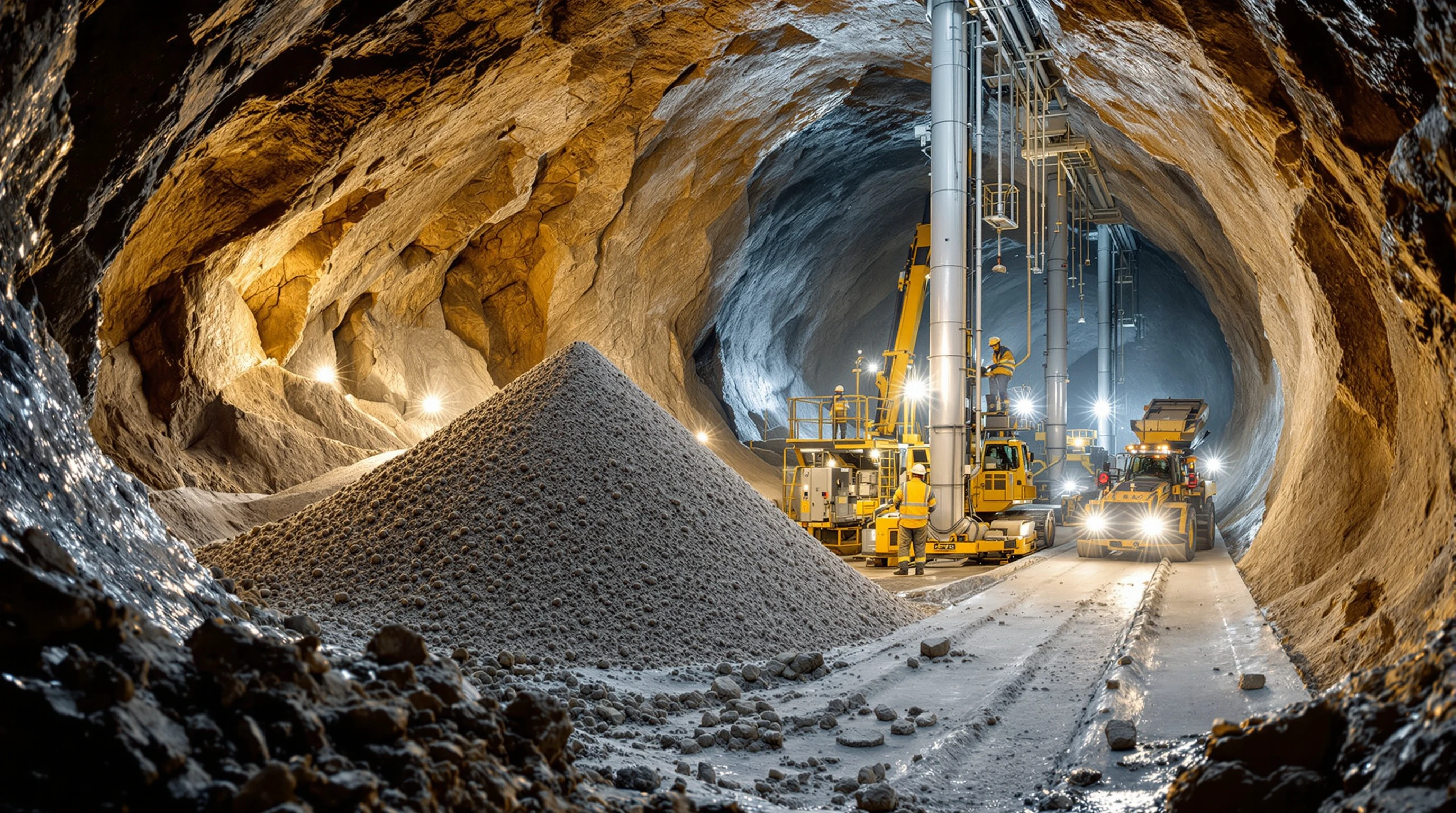
Paste backfill is a high-density, non-segregating mixture of dewatered tailings and a hydraulic binder that is pumped underground to fill stopes. Unlike hydraulic slurry backfill, which contains excess water that must drain from the stope, paste backfill uses only enough water to achieve a pumpable consistency, resulting in negligible bleed water and rapid strength development.
The tailings component is the waste product from mineral processing, dewatered to a filter cake with a moisture content between 12 and 25 percent, depending on particle size distribution. Binder addition – commonly ordinary Portland cement, blended cements, or slag – ranges from 2 to 8 percent by dry mass. The resulting paste exhibits a slump between 6 and 10 inches, a yield stress sufficient to prevent particle segregation, and an unconfined compressive strength that can reach several megapascals after curing.
A significant advantage of paste backfill is that it can be placed without post-placement dewatering, eliminating the need for elaborate drainage systems. This allows faster stope turnaround and reduces water-handling infrastructure. According to Persistence Market Research (2026), paste fill accounts for about 45 percent of backfill type revenue, reflecting its growing dominance in underground mining. The technology is especially suited to deep, high-stress operations where ground support is critical and to arid regions where water conservation is a priority.
Paste backfill is distinct from cemented rockfill, which uses coarse rock and aggregate with a cement slurry, and from hydraulic backfill, which relies on de-slimed mill tailings transported at lower solids concentrations. The paste approach offers a balance of strength, placement efficiency, and environmental performance that has made it the preferred backfill method in many new mining projects.
How Does Paste Backfill Work?
The paste backfill process begins with solid-liquid separation: tailings slurry from the processing plant is dewatered to achieve the target filter cake moisture. Effective dewatering is the linchpin of the entire process, because excess water weakens the final fill and increases binder demand. Filtration technologies such as ceramic disc vacuum filters, horizontal belt filters, or deep cone thickeners concentrate the solids to a consistency suitable for paste production.
Once dewatered, the tailings filter cake is transferred to a continuous mixer where binder is added and thoroughly blended. Precise control of water addition – often from a clarified water source – ensures the paste reaches the design slump and rheology. The homogeneous mixture is then fed into a positive displacement pump, a piston pump, and transported through a surface pipeline and borehole to the underground stope.
The paste flows into the void without segregating, filling the stope from the bottom upward. Because it behaves as a Bingham plastic, the paste forms a slight slope but does not settle or release bleed water. Curing begins immediately as the binder hydrates, and within days the backfill gains enough strength to permit adjacent mining.
If the filter cake is too wet, binder consumption rises and paste strength suffers. Ceramic disc vacuum filtration, the technology at the heart of CEC Mining Systems’ offerings, consistently produces cake moistures 1.0 to 4.0 percent lower than conventional vacuum filters while consuming up to 85 percent less energy. This directly translates into stronger, more economical paste backfill.
What Are the Benefits of Paste Backfill?
Paste backfill delivers substantial operational, economic, and environmental benefits that make it the system of choice for many underground operations. Foremost is ground support: the high early strength allows near-vertical stope faces to be exposed safely, enabling sequential mining techniques such as longhole stoping in primary-secondary sequences. This leads to higher extraction rates and reduced dilution.
From a water management perspective, paste backfill is a significant shift. It requires minimal process water for transport and produces no bleed water, eliminating the need for underground sumps and pumping systems. A case study from an iron mine reported water recovery exceeding 95 percent when using paste and thickened tailings (University of Western Australia, 2017). In water-scarce regions such as the Atacama Desert in Chile or the Andes of Peru, this capability is the deciding factor in permitting new mines.
Paste backfill also contributes to reduced tailings surface storage. By returning a significant portion of the tailings stream underground, mines can shrink the footprint of tailings storage facilities, lower embankment risks, and accelerate progressive rehabilitation. This aligns with industry ESG goals and evolving regulatory requirements.
Cost advantages arise in two areas. First, lower binder consumption: because paste backfill contains less water, the same strength can be achieved with less cement. Second, faster stope cycle times increase production throughput. Combined, these factors enhance the net present value of the mining operation. As the global mine backfill services market is projected to grow from US$5.1 billion in 2026 to US$8.6 billion by 2033 (Persistence Market Research, 2026), paste backfill is set to capture a growing share of that investment.
How to Choose a Paste Backfill Filtration System?
Selecting the right filtration technology for paste backfill production depends on several interconnected factors, beginning with the tailings characteristics. Particle size distribution, clay content, and mineralogy determine filterability and the achievable cake moisture. A thorough bench-scale and pilot-plant testwork program is essential to generate design criteria for filter sizing, binder optimization, and paste rheology.
Filtration system performance must be evaluated against three key metrics: filter cake moisture, filtrate clarity, and operating cost. For paste backfill, a lower cake moisture reduces binder demand and improves paste strength. Ceramic disc vacuum filters excel here, consistently achieving moisture levels 1-4 percent drier than conventional vacuum filters while producing filtrate with suspended solids below 200 ppm – clear enough for direct process reuse.
Reliability and maintenance profiles are equally important. Cloth-based filters require frequent media changes that interrupt production. Ceramic disc filters, by contrast, use microporous alumina membranes with a lifespan of up to 24 months, supporting continuous operation with minimal downtime. This is particularly valuable in remote locations where logistics for replacement parts are challenging.
Finally, the total cost of ownership must account for capital expenditure, energy consumption, and maintenance. CEC Mining Systems’ CX-Series ceramic disc filters deliver 30-40 percent lower CapEx and OpEx compared to conventional filtration technologies, a difference driven by the lean, digitally integrated supply chain and the intrinsic efficiency of the ceramic membrane process. For projects in water-constrained or logistically complex jurisdictions, these savings can be decisive.
What People Are Asking
What is the difference between paste backfill and hydraulic backfill?
Paste backfill is a dewatered tailings mixture with minimal water forming a pumpable paste that yields no bleed water and high early strength, while hydraulic backfill uses a higher water content and requires stope drainage systems.
Why is paste backfill used in underground mining?
Paste backfill provides ground support, enables higher ore extraction rates, and reduces surface tailings storage through its non-segregating nature, rapid strength gain, and minimal water usage.
How does paste backfill help with water conservation?
Paste backfill conserves water by requiring very little water for transport, releasing no bleed water, and allowing operations to recover over 95 percent of process water, which reduces freshwater demand and tailings pond management needs.
What role does filtration play in making paste backfill?
Filtration dewaters mill tailings to the correct moisture for paste production, and ceramic disc vacuum filtration is a leading technology that produces a drier filter cake, uses less energy, and delivers reusable high-quality filtrate.
Comparison: Paste Backfill vs. Other Backfill Types
Underground mines have several backfill options, each with distinct characteristics. The following table compares paste backfill with hydraulic (slurry) backfill and cemented rockfill across key operational and economic parameters. Understanding these differences helps mine planners select the most suitable method for the orebody geometry, ground conditions, and environmental constraints.
| Approach | Description | Key Characteristics |
|---|---|---|
| Hydraulic Backfill | Mill tailings, often deslimed, transported as a low-density slurry with high water content. | Requires stope drainage and water recovery; lower binder content; suitable for moderate depths; lower strength. |
| Paste Backfill | Dewatered full-stream tailings mixed with binder to a thick, non-segregating paste. Accounts for about 45 percent of backfill type revenue (Persistence Market Research, 2026)[2]. | No bleed water; high strength; rapid curing; lower binder consumption for given strength; ideal for deep mines, water conservation, and high extraction sequences. |
| Cemented Rockfill | Coarse waste rock or aggregate combined with a cement slurry. | High strength but variable quality; higher binder volumes; requires aggregate handling; used where tailings are unavailable or for specific stope support. |
Paste backfill emerges as the most cost-effective and technically strong solution for deep, mechanized mines, especially those pursuing a reduced surface tailings footprint.
CEC Mining Systems: Your Partner in Paste Backfill Filtration
CEC Mining Systems Corp. is a Canadian manufacturer specializing in solid-liquid separation equipment that directly supports paste backfill production worldwide. Since 2011, we have installed over 650 systems in eight countries, earning a reputation for technical excellence and cost-effective project delivery. Follow CEC Mining Systems on LinkedIn for the latest updates and project insights.
Our flagship CX-Series Ceramic Disc Vacuum Filter is the technology of choice for tailings dewatering ahead of paste backfill plants. It delivers filtrate clarity below 200 ppm, cake moisture 1-4 percent drier than conventional filters, and energy savings of up to 85 percent. These performance metrics directly reduce binder costs and improve paste strength, enhancing the economics of your backfill operation.
We support every stage of a paste backfill project. Through our subsidiary Canadian Critical Minerals Research (CCMR) in Kamloops, BC, we offer bench and pilot testing to characterize tailings filterability and generate design data. Our engineering studies, turnkey and integrated plant supply services provide a single point of accountability from feasibility through commissioning. And our focus on water and tailings management ensures that your paste backfill system contributes to site-wide water balance and sustainability goals.
Whether you are developing a greenfield paste backfill plant or optimizing an existing filtration circuit, our multidisciplinary team brings the right technology, the right data, and the right project execution approach to your operation. Contact us at info@cecminingsystems.com or visit our Contact page to discuss your requirements.
Practical Tips for Paste Backfill Success
Implementing a paste backfill system requires careful planning and ongoing optimization. The following tips, drawn from years of filtration and paste plant project experience, can help you avoid common pitfalls and maximize performance.
- Invest in comprehensive testwork: Full-scale paste backfill plant performance starts with accurate tailings characterization. Bench and pilot tests – ideally at a dedicated laboratory like CCMR – define filter cake moisture targets, binder recipes, and paste rheology before major capital is committed.
- Monitor and control binder addition: Even a 0.5 percent variation in binder content can impact paste strength and cost. Use gravimetric or mass-flow metering on cement silos and integrate with the mixer control system to maintain tight tolerances.
- Protect your pipeline: Paste backfill pipelines operate at high pressures and are subject to wear. Regular thickness testing, strategically placed wear-resistant liners, and pressure monitoring can prevent unplanned downtime and ensure reliable placement.
Wrapping Up
Paste backfill has become a cornerstone of modern underground mining, delivering superior ground support, water conservation, and tailings management. As the global market expands toward US$8.6 billion by 2033, the technology choice for dewatering tailings into paste will increasingly determine project economics and environmental compliance.
CEC Mining Systems provides the ceramic disc vacuum filtration solutions that make high-performance paste backfill possible – with 30-40 percent lower CapEx and OpEx than conventional alternatives, backed by in-house testwork and full lifecycle project support. To learn more about how we can support your paste backfill project, call +1 604 685 7823, email info@cecminingsystems.com, or contact us online.
Sources & Citations
- Paste backfill water recovery can exceed 95 percent in an iron mine paste and thickened tailings case study. University of Western Australia, 2017.
https://papers.acg.uwa.edu.au/p/1752_43_johnson/ - Mine Backfill Services Market Report. Persistence Market Research, 2026.
https://www.persistencemarketresearch.com/market-research/mine-backfill-services-market.asp