Filter press mining is a proven solid-liquid separation method used in tailings dewatering, concentrate filtration, and water recovery – this guide covers how it works, key technologies, and how to choose the right system for your operation.
Quick Summary
Filter press mining is a solid-liquid separation process that forces slurry through filter media under pressure or vacuum to produce a dewatered filter cake and clean filtrate. Mining operations use filter presses to dewater tailings for dry stacking, filter concentrates to meet moisture specifications, and recover process water for reuse in the plant circuit.
Filter Press Mining in Context
- Two Brazilian iron ore operations treated 13,344 and 10,500 tonnes of dry iron ore tailings per day using filter press technology in 2026, while recovering 9,700 and 8,800 m³ of water per day respectively (Australian Centre for Geomechanics, 2026).[1]
- A pilot plant using enhanced vacuum belt filtration reduced average moisture content by 4.2 percentage points for CIP tailings and by 5.7 percentage points for TUF tailings compared with a conventional vacuum belt filter (Springer, 2025).[2]
- Belt filter press capital cost ranges from US$25,000 to US$220,000 depending on belt width and throughput, as reported by a 2026 industry pricing analysis (Hydropure Water, 2026).[3]
What Is Filter Press Mining?
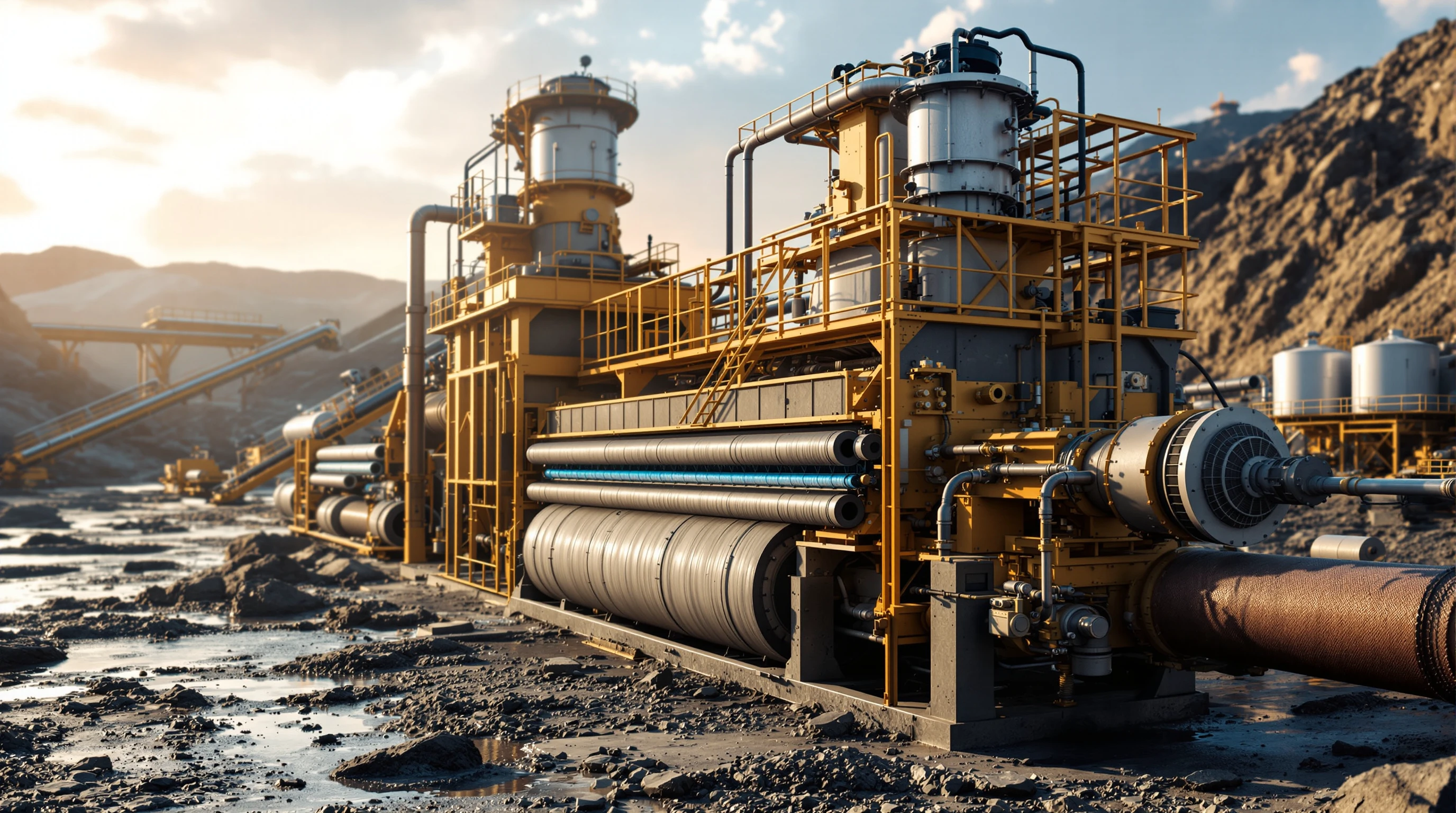
Filter press mining refers to the application of pressure- or vacuum-driven filtration equipment to separate solids from liquid in mineral processing and tailings management circuits. A filter press forces slurry through a permeable filter medium – typically woven cloth, ceramic membranes, or belt fabric – which retains solid particles to form a filter cake while allowing liquid to pass through as filtrate. The result is a dewatered solid suitable for stacking, transport, or further processing, and a recovered liquid stream returned to the process circuit.
Mining operations deploy filter press technology across three primary applications: tailings dewatering and dry stacking to eliminate or reduce the footprint of conventional tailings storage facilities; concentrate filtration to achieve precise moisture targets for smelter contracts and export shipping; and paste backfill preparation in underground hard rock mines, where low-moisture filter cake reduces binder demand and cuts cement costs. CEC Mining Systems Corp. designs and delivers filter press and ceramic disc vacuum filtration systems specifically engineered for these mining applications, with projects completed across Latin America, Africa, Australia, and Canada.
The broad category of filter press mining technology includes recessed plate filter presses, membrane plate filter presses, vacuum belt filters, ceramic disc vacuum filters, and horizontal belt filters. Each type differs in the mechanism for pressure application, the filter media employed, and the throughput and moisture performance it achieves. Understanding these distinctions is important before selecting a filtration system for a specific ore type, throughput requirement, or regulatory context. A. Roux, in a 2025 conference paper on filtered tailings deposition design, noted that “Among the new approaches promoted by the GISTM is the recommended use of filtered stack tailings.”[4]
How Does a Filter Press Work in Mining Applications?
A filter press in mining operates by feeding a slurry of fine solids and process water into a series of chambers formed between filter plates, then applying pressure or vacuum to drive the liquid through the filter medium while retaining the solids as a consolidated cake. The specific mechanism varies by filter type, but all filter press mining systems share the same fundamental goal: maximize solids capture, minimize residual cake moisture, and produce a filtrate clean enough for direct return to the process water circuit.
In a recessed plate or membrane plate filter press, slurry is pumped into chambers between sealed filter plates. As pressure builds – either through feed pump pressure alone or through an additional inflatable membrane that squeezes the cake – liquid is forced through the filter cloth and exits via drainage channels in the plate surface. When the chambers are full and target pressure is achieved, the press opens and the filter cake is discharged by gravity or mechanically. Cycle times range from 30 minutes to several hours depending on slurry filterability, target moisture, and press design.
Ceramic disc vacuum filters – a distinct class of filter press mining equipment – use microporous alumina ceramic membranes instead of woven cloth. Rotating ceramic discs pass through a slurry basin; vacuum and capillary action pull liquid through the membrane while solids accumulate on the disc surface as a filter cake. The ceramic membrane pore size, at 0.75 to 3.0 microns, captures ultrafine particles that conventional cloth filters pass, delivering filtrate quality in the range of 50 to 200 parts per million suspended solids. This clean filtrate is returned directly to process circuits without additional clarification. You can learn more about the performance characteristics of CX-Series Ceramic Disc Vacuum Filter – proprietary ceramic membrane filtration technology for tailings dewatering, concentrate filtration, and paste backfill; 30-40% CapEx/OpEx savings versus conventional technologies.
Horizontal belt filters apply vacuum across a moving filter belt, drawing liquid through the fabric while the belt carries the forming cake through dewatering, washing, and discharge zones in a continuous sequence. This design suits applications requiring counter-current cake washing alongside dewatering, such as certain metallurgical leach residue or chemical processing streams where washing efficiency is as important as moisture reduction.
Filter Press Mining for Tailings Dewatering and Dry Stacking
Filter press mining plays a central role in tailings dry stacking, a method of tailings disposal that produces a dewatered, trafficable filter cake stacked and compacted in engineered facilities rather than deposited as slurry in a conventional tailings storage facility. Dry stacking reduces or eliminates the need for large tailings ponds, lowers dam failure risk, and supports water recovery in water-constrained mining regions including the Chilean Atacama, the Peruvian Andes, Mexico, Western Australia, and parts of southern Africa.
S. Wait, writing in a 2025 conference paper on enhanced vacuum belt filtration, observed that “Investigation into, and uptake of, filtered tailings continues to grow throughout the globe.” – S. Wait[5] This growth is driven by tightening regulatory requirements for tailings storage facilities, increasing investor scrutiny of tailings-related ESG risk, and the practical need to recover and reuse process water in regions where freshwater availability limits mine production.
Real-world scale shows that filter press mining systems handle very large tailings volumes. In 2026, documented Brazilian iron ore operations used filter press technology to treat 13,344 and 10,500 tonnes of dry iron ore tailings daily while recovering 9,700 and 8,800 m³ of water per day respectively (Australian Centre for Geomechanics, 2026).[1] These figures confirm that filtered tailings management is not limited to small or niche operations – the technology scales to meet the demands of major production facilities.
Ultrafine tailings remain a technical challenge for filter press mining systems. A 2026 Taylor & Francis review noted that coarse tailings particles fall in the 20 to 150 µm range, while ultrafines below 10 µm present limited dewatering performance with conventional technology (Taylor & Francis Online, 2026).[6] Ceramic disc vacuum filters, with their sub-micron membrane pore sizes, are better suited to ultrafine tailings than conventional cloth-based filter presses, making technology selection a critical step for operations with fine-grained ore mineralogy. The Water and Tailings Management solutions developed by CEC Mining Systems address these fine-particle challenges through ceramic membrane filtration and integrated thickening upstream of the filter press circuit.
How Do You Select the Right Filter Press Technology for Your Mine?
Selecting the right filter press mining technology requires matching equipment design to the specific characteristics of your tailings or concentrate stream, your throughput targets, your target moisture, and your project’s regulatory and water balance requirements. No single filter press type suits every application – the choice between a recessed plate filter press, membrane filter press, ceramic disc vacuum filter, or horizontal belt filter depends on a structured evaluation of feed properties and project constraints.
The most important feed property governing filter press selection is particle size distribution. Coarser, more permeable tailings are well-suited to belt filter presses and horizontal belt filters, which achieve high throughput rates at acceptable moisture levels. Fine and ultrafine tailings – common in copper, gold, and platinum group metal operations – benefit from ceramic disc vacuum filtration, where sub-micron ceramic membranes capture particles that cloth-based systems pass into the filtrate. K. Wilkinson’s 2025 review paper on alternative dewatering technologies for South African platinum tailings highlighted the importance of matching technology selection to specific mineralogy and particle size when assessing dewatering performance for platinum group metal tailings.[7]
Throughput and site logistics also shape the selection decision. Plate-and-frame and recessed plate filter presses operate in batch cycles, requiring chamber filling, pressing, cake discharge, and cloth washing between each cycle. This limits instantaneous throughput compared with continuously operating ceramic disc or belt filter systems. For large-scale tailings operations requiring continuous high-volume filtration, continuous vacuum filter technologies offer a significant operational advantage. Bench-scale and pilot-plant testwork is the most reliable way to generate the filterability data needed to size equipment correctly and establish realistic moisture targets before committing to a full-scale design. Bench and Pilot Testing – giving you the data and confidence to power your project from the earliest stages is a service offered by CEC Mining Systems through its CCMR subsidiary in Kamloops, BC, using AI-assisted benchmarking to accelerate project de-risking from feasibility through detailed engineering.
Operating cost is a third selection criterion. Conventional cloth filter presses require regular filter cloth replacement, which adds to both direct materials cost and planned downtime. Ceramic disc vacuum filters eliminate filter cloth from the operating cost equation – ceramic membranes have a service life of up to 24 months per campaign – while also reducing energy consumption by up to 85% compared with conventional vacuum filter designs. For operations in remote jurisdictions or water-constrained regions where operational efficiency directly affects site economics, these ongoing cost differences compound significantly over the life of the installation. G. S. Maré’s 2025 conference paper, “Innovation in tailings dewatering: case studies of the successful application of filter presses,” – G. S. Maré[8] – documents how operational cost outcomes in real projects validate technology selection decisions made at feasibility stage.
Your Most Common Questions
What is a filter press used for in mining?
A filter press in mining separates water from solid particles in tailings, concentrates, and process slurries to produce a dewatered cake and recover clean process water for reuse in the plant circuit. Filter press mining equipment is applied across three primary circuits: tailings dewatering to enable dry stacking and reduce tailings storage facility footprint; concentrate filtration to achieve the low moisture content required by smelter contracts and export shipping specifications; and paste backfill preparation in underground mines, where a lower-moisture cake reduces the cement binder needed in the paste recipe. The recovered filtrate – cleaned to 50-200 parts per million suspended solids in ceramic disc systems – returns directly to the process water circuit, reducing freshwater demand. In water-constrained regions such as Chile, Peru, and Western Australia, this water recovery function is often as economically important as the solids management outcome.
What is the difference between a filter press and a vacuum filter in mining?
A filter press applies positive mechanical pressure to force liquid through filter media, while a vacuum filter draws liquid through the media using negative pressure created by a vacuum pump. Both types are used in filter press mining applications, but they differ in operating mechanism, achievable moisture, throughput mode, and operating cost. Conventional plate-and-frame or membrane filter presses operate in batch cycles – fill, press, discharge – and achieve very low cake moisture, sometimes below 15% in optimized applications. Vacuum filters, including ceramic disc and belt filter designs, operate continuously, which improves throughput consistency and reduces labor requirements. Ceramic disc vacuum filters achieve filtrate quality of 50 to 200 parts per million suspended solids and produce filter cake 1.0 to 4.0% drier than conventional vacuum belt filters at comparable throughput rates, without the cloth replacement costs associated with fabric-based vacuum systems.
How much does a filter press cost for a mining operation?
Filter press mining capital costs vary by technology type, capacity, and site-specific requirements, with belt filter press equipment alone ranging from US$25,000 to US$220,000 depending on belt width and throughput (Hydropure Water, 2026).[3] This equipment-only range does not include installation, civil works, piping, instrumentation, or the upstream and downstream equipment required in a complete tailings dewatering or concentrate filtration circuit. Full turn-key filter press mining plant costs depend on project scale, site location, and the scope of engineering and project delivery services included. Ceramic disc vacuum filter systems carry a higher initial equipment cost than conventional belt filter presses but deliver 30 to 40% lower combined CapEx and OpEx over the project life when reduced energy consumption, eliminated cloth replacement costs, and higher water recovery are factored into the comparison. Bench-scale testwork conducted before equipment selection is the most effective way to establish realistic sizing, operating cost, and capital cost inputs for project budgeting.
Can filter press mining technology handle ultrafine tailings?
Ceramic disc vacuum filters are the most effective filter press mining technology for ultrafine tailings, using microporous alumina membranes with pore sizes of 0.75 to 3.0 microns to capture particles that conventional cloth-based systems pass into the filtrate. Conventional plate-and-frame filter presses and vacuum belt filters struggle with ultrafine tailings – particles below 10 µm – because the filter media pore size is not small enough to retain the finest fractions, leading to elevated filtrate turbidity and reduced water recovery quality. A 2026 Taylor & Francis review identified limited dewatering of ultrafine tailings as a primary challenge for the industry, noting that coarse tailings particles fall in the 20 to 150 µm range (Taylor & Francis Online, 2026).[6] For platinum group metal tailings, copper tailings, and other fine-grained ore types, ceramic disc vacuum filtration is the preferred technology. Pilot testwork on representative tailings samples is required to confirm filterability and select the correct membrane pore size before committing to full-scale design.
Comparing Filter Press Mining Technologies
Filter press mining encompasses several distinct technology types, each with different operating mechanisms, throughput modes, and performance characteristics. The table below compares the four most common approaches across criteria relevant to tailings dewatering and concentrate filtration decisions. Selecting the wrong technology for your feed type and throughput requirement is one of the most costly mistakes in filtration plant design – this comparison provides a starting framework before testwork data is available.
| Technology | Operating Mode | Best Suited For | Filtrate Quality | Relative OpEx |
|---|---|---|---|---|
| Recessed/Membrane Plate Filter Press | Batch | Fine to medium tailings, concentrate, low-moisture targets | Moderate (cloth-dependent) | Medium-High (cloth replacement, labor) |
| Ceramic Disc Vacuum Filter | Continuous | Fine and ultrafine tailings, concentrate filtration, paste backfill | High (50-200 ppm suspended solids) | Low (no cloth, up to 85% energy saving)[1] |
| Horizontal Belt Filter | Continuous | High-throughput dewatering with counter-current washing | Moderate (cloth-dependent) | Medium |
| Vacuum Belt Filter | Continuous | Coarser tailings, intermediate throughput | Moderate | Medium (cloth and maintenance costs) |
How CEC Mining Systems Supports Filter Press Mining Projects
CEC Mining Systems Corp. (CECMS) is a Canadian manufacturer and project delivery company specializing in solid-liquid separation for the global mining industry. With over 650 systems installed in eight countries since 2011, CECMS provides filter press mining solutions across the full project lifecycle – from bench-scale testwork and feasibility engineering through EPC/EPCM/BOOT project delivery, commissioning, and long-term operational support.
The flagship CX-Series Ceramic Disc Vacuum Filter is CECMS’ proprietary technology for tailings dewatering, concentrate filtration, and paste backfill applications. The CX-Series delivers filtrate quality of 50 to 200 parts per million suspended solids, filter cake that is 1.0 to 4.0% drier than conventional vacuum filters at comparable throughput, and up to 85% lower energy consumption than conventional vacuum filter designs. The world’s largest ceramic filter – the CX12-204 at 204 m² of filtration area – enables economies of scale for large-capacity tailings plants. CECMS also supplies Horizontal Belt Filter – heavy-duty washing and high-capacity dewatering for demanding mineral processing applications and the MIR Steel Belt Dryer – continuous and efficient concentrate dehydration with zero dust generation or vibration for applications requiring precise final moisture control beyond what filtration alone achieves.
CECMS delivers filter press mining projects through flexible contracting structures – equipment supply, EPC, EPCM, or BOOT – allowing the delivery model to match the client’s project structure and risk appetite. The company’s Engineering Studies, Turnkey and Integrated Plant Supply – save time, reduce costs, and build greater efficiency through full-cycle project execution service covers the full scope from conceptual engineering through plant commissioning and first-hundred-days operational support. ISO 9001 and ISO 14000 certifications back CECMS’ quality and environmental management systems across all project activities.
To discuss your filter press mining project requirements, contact CEC Mining Systems at +1 604 685 7823, email info@cecminingsystems.com, or submit an inquiry through the contact form at cecminingsystems.com/contact-us/. Follow CEC Mining Systems on LinkedIn for project updates and technical publications.
How to Implement Filter Press Mining in 5 Steps
Step 1: Characterize Your Feed with Bench-Scale Testwork
Before selecting any filter press mining equipment, commission bench-scale and pilot-plant testwork on representative samples of your tailings or concentrate. Filterability, particle size distribution, mineralogy, and slurry rheology all govern which filter press technology will achieve your target moisture and throughput – and no equipment supplier can give you reliable sizing without this data. AI-assisted benchmarking, as used by CECMS through its CCMR laboratory in Kamloops, BC, reduces the time from sample receipt to preliminary design parameters and accelerates your feasibility schedule.
Step 2: Define Your Moisture and Throughput Targets
Establish the filter cake moisture content and daily throughput your project requires before evaluating equipment options. For tailings dry stacking, target moisture is governed by geotechnical stability requirements for the stack – at 15 to 20% moisture by mass for many ore types, though this varies with mineralogy. For concentrate filtration, target moisture is set by smelter contract or shipping specification. Knowing these targets upfront allows you to evaluate filter press technology options against confirmed performance criteria rather than vendor claims alone.
Step 3: Select the Right Filter Press Technology for Your Feed Type
Match your filter press mining technology to your feed particle size, throughput mode preference, and operating cost constraints. Use the testwork data from Step 1 to compare ceramic disc vacuum filters, plate-and-frame filter presses, and belt filter systems against your moisture target and throughput requirement. For fine and ultrafine tailings, ceramic disc technology outperforms cloth-based systems in both filtrate quality and long-term operating cost. For applications requiring counter-current washing alongside dewatering, a horizontal belt filter is better suited.
Step 4: Integrate the Filter Press into a Complete Plant Flowsheet
A filter press mining system does not operate in isolation – it requires upstream thickening to pre-concentrate the feed slurry, flocculant addition systems to optimize solids settling and underflow rheology, and downstream handling equipment for filter cake conveyance and stacking. Ensure your project flowsheet accounts for the full solid-liquid separation circuit, not only the filter press itself. A brownfield audit of existing thickening and filtration infrastructure, where applicable, identifies bottlenecks and integration risks before detailed engineering begins.
Step 5: Plan for Commissioning and Operational Readiness
Filter press mining plants require structured commissioning and operator training to reach design performance quickly and safely. Plan for a HAZID/HAZOP review before mechanical completion, a formal commissioning and startup sequence with the equipment supplier’s technical team on site, and a post-commissioning support phase – covering the first hundred days of production – to optimize filter performance as feed conditions stabilize. Remote monitoring and predictive analytics programs allow ongoing performance tracking without requiring permanent on-site specialist presence after startup is complete.
The Bottom Line
Filter press mining technology is a proven enabler of responsible tailings management, efficient water recovery, and precise concentrate moisture control in modern mining operations. From ceramic disc vacuum filters handling ultrafine tailings to large-scale plate filter presses processing more than 13,000 tonnes of dry tailings per day in Brazilian iron ore operations, the technology continues to prove its value at industrial scale. Selecting the right filter press system requires feed characterization through testwork, a clear understanding of moisture and throughput targets, and a full-circuit flowsheet that integrates thickening, filtration, and downstream solids handling.
CEC Mining Systems Corp. supports filter press mining projects from bench-scale testwork through turn-key plant delivery and long-term operational support. To discuss your tailings dewatering, concentrate filtration, or paste backfill filtration project, contact the CECMS team at +1 604 685 7823 or info@cecminingsystems.com. You can also use the Find Your Solution tool on the CECMS website to match your application to the right technology – and start your project on solid ground.
Sources & Citations
- Dry stacking of iron ore tailings: how Brazilian operations inspired… Australian Centre for Geomechanics, 2026.
https://papers.acg.uwa.edu.au/d/2555_04_Gerards/04_Gerards.pdf - Enhanced vacuum belt filtration pilot plant results. Springer, 2025.
https://link.springer.com/article/10.1007/s42461-021-00378-y - Belt filter press for mining wastewater: cost in 2026, pricing, specs, buyer’s guide. Hydropure Water, 2026.
https://hydropurewater.com/blog/6136-belt-filter-press-for-mining-wastewater-cost-in-2026-pricing-specs-buyer-s.html - Preliminary framework for filtered tailings deposition design. Australian Centre for Geomechanics, 2025.
https://papers.acg.uwa.edu.au/d/2555_06_Roux/06_Roux.pdf - Enabling dry stack tailings disposal through enhanced vacuum belt filtration. Australian Centre for Geomechanics, 2025.
https://papers.acg.uwa.edu.au/p/2555_45_Wait/ - Review of alternative dewatering technologies – ultrafine tailings particle size data. Taylor & Francis Online, 2026.
https://www.tandfonline.com/doi/abs/10.1080/08827508.2025.2486955 - Review of alternative dewatering technologies for application to South African platinum tailings. Australian Centre for Geomechanics, 2025.
https://papers.acg.uwa.edu.au/p/2555_01_Wilkinson/ - Innovation in tailings dewatering: case studies of the successful application of filter presses. Australian Centre for Geomechanics, 2025.
https://papers.acg.uwa.edu.au/p/2555_07_Mare/