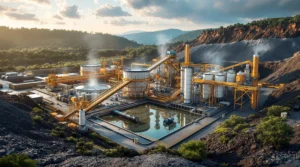
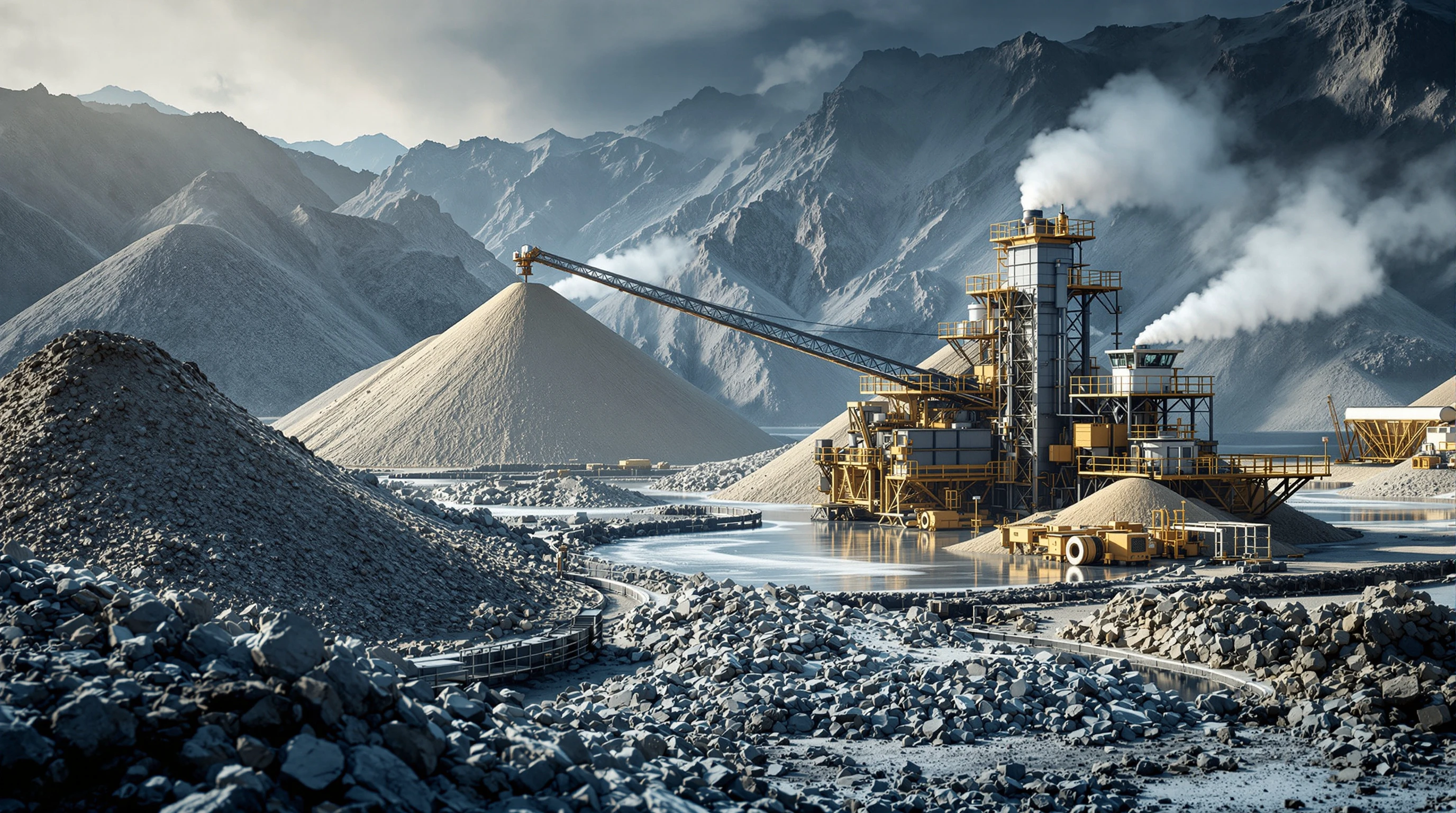
Dry stack tailings is a filtered tailings management method that removes water from mine waste before deposition, reducing dam failure risk and recovering process water for reuse in mining operations.
Article Snapshot
Dry stack tailings is a tailings management method in which mine waste solids are mechanically dewatered through filtration, then deposited in a stable, compacted stack rather than a conventional slurry pond. This approach recovers process water, reduces dam failure risk, and shrinks the tailings storage footprint at mine sites worldwide.
Dry Stack Tailings in Context
- Only 13 dry-stack tailings facilities were constructed globally in the decade prior to 2021, despite the method being identified as an industry priority (Scientific Reports, 2021)[1].
- Since 1970, the share of new tailings facilities designed as dry-stack has remained between 3% and 6% of all new facilities constructed (Scientific Reports, 2021)[1].
- One international mining company operates or holds majority ownership in 53 of the 74 dry-stack facilities identified in a 2021 research dataset (Scientific Reports, 2021)[1].
- Documented dry stack tailings project specifications have cited target solids content of 85% for filtered tailings prior to stacking (Canadian environmental assessment documentation, 2025)[2].
What Are Dry Stack Tailings?
Dry stack tailings is a mine waste management technique in which tailings – the finely ground rock and process residues generated during mineral extraction – are mechanically dewatered to a high solids content before being transported to and placed in an engineered stack. Unlike conventional slurry-based tailings storage facilities (TSFs), where wet slurry is pumped into impounded dams, dry stack tailings systems produce a filter cake or paste that is firm enough to be trucked, conveyed, or stacked without relying on a retaining embankment to hold back liquid. CEC Mining Systems Corp. has delivered ceramic disc-vacuum filtration systems and turn-key tailings dewatering plants that support dry stacking across Latin America, Africa, Australia, and Canada.
The dewatering step is the defining characteristic of any dry stack tailings approach. As defined in the research literature, dry-stack facilities are those that “employ a type of dewatering scheme,” and that category “includes both in-situ dewatering of tailings and the filtering of tailings prior to deposition” (David Kemp, University of Queensland, 2021)[1]. In practice, the most common method used in modern operations is filtration – either vacuum or pressure filtration – which reduces tailings moisture to a level that allows mechanical handling and structural stacking. Documented specifications for filtered tailings stacking have cited target solids content of 85% by weight (Canadian environmental assessment documentation, 2025)[2], though actual design targets vary with mineralogy, climate, and geotechnical requirements at each site.
Dry stack tailings is particularly relevant in water-constrained mining jurisdictions such as Chile’s Atacama region, the Peruvian Andes, parts of Western Australia, and Mexico, where regulatory pressure to reduce freshwater consumption and the physical scarcity of water both drive interest in high-recovery solid-liquid separation. A study published in Scientific Reports found that global adoption of dry stacking remains low relative to industry intentions, creating both a technical gap and a substantial opportunity for filtration-focused project developers and equipment suppliers.
Large-scale dry stack tailings projects show the engineering complexity involved. A project at KML was planned to produce 12 million tonnes per annum (Mtpa) of dry-stacked tailings over a 35-year operating life (Government of Western Australia, EPA referral documentation, 2021)[3], illustrating that filtration plant design must accommodate sustained high-throughput dewatering over the full mine life. Understanding the fundamentals of what dry stacking requires – high-capacity filtration, geotechnical stack design, and reliable water recovery – is the starting point for any project team evaluating the approach.
How Does Filtration Technology Enable Dry Stacking?
Filtration is the enabling technology for dry stack tailings: without mechanical dewatering capable of producing a stackable filter cake at scale, the dry stacking method cannot be practically implemented. The filtration step sits between the mineral processing circuit – which generates a tailings slurry – and the stacking area, where dewatered solids are placed. The performance of the filter determines the moisture content of the cake, the quality of the recovered water, and the throughput rate at which the entire tailings management system operates.
Two primary filtration technologies dominate modern dry stack tailings plant design: vacuum filtration and pressure filtration. Vacuum filtration systems, including ceramic disc vacuum (CDV) filters, use suction to draw liquid through a porous membrane, forming a filter cake on the membrane surface. The CX-Series Ceramic Disc Vacuum Filter uses microporous alumina ceramic membranes with pore sizes ranging from 0.75 to 3.0 microns, achieving filtrate quality below 200 ppm suspended solids – clean enough for direct return to the process water circuit without further clarification. This level of water recovery is a significant advantage in water-stressed jurisdictions where every litre of recovered process water reduces freshwater demand and improves the site water balance.
Pressure filters, including membrane plate-and-frame and horizontal belt filters, apply positive pressure to squeeze the filter cake to lower moisture content, which is advantageous in climates or with mineralogies where achieving drier cake is critical for geotechnical stack stability. The choice between vacuum and pressure filtration for a given dry stack project depends on tailings particle size distribution, required cake moisture, throughput capacity, capital cost, and operating cost over the project life. Bench-scale and pilot-plant testwork is the only reliable way to generate the filtration design data needed to make that selection with confidence.
The Bench and Pilot Testing service offered by CEC Mining Systems through its Canadian Critical Minerals Research (CCMR) subsidiary in Kamloops, BC provides filterability characterization across a range of tailings mineralogies, generating validated inputs for filter sizing, water balance modelling, and capital cost estimation. An AI-assisted benchmarking tool developed by CECMS reduces the time from sample receipt to preliminary design parameters, helping project teams advance feasibility schedules. The CX-Series is available up to the CX12-204 – the world’s largest ceramic filter at 204 m² of filtration area – enabling modular, scalable plant configurations that grow with production volumes without requiring a full plant redesign.
Key Benefits and Challenges of Dry Stack Tailings
Dry stack tailings offers a defined set of operational, environmental, and financial advantages over conventional slurry-based tailings pond management, alongside real engineering and cost challenges that project teams must address in design. Recognizing both sides of the ledger is necessary for accurate feasibility assessment and informed decision-making.
The primary benefit of dry stacking is the elimination or significant reduction of the tailings impoundment – the engineered dam structure that contains wet slurry in conventional TSFs. Conventional tailings dams are among the highest-consequence failure risks in the mining industry; dam failures have caused fatalities, environmental damage, and multi-billion-dollar liabilities at operations around the world. By removing the bulk of the liquid from tailings before deposition, dry stacking removes or substantially reduces the hydrostatic forces that drive dam failure, improving the geotechnical stability of the tailings mass. This risk reduction translates directly into reduced liability exposure and improved social licence for mining operations.
Water recovery is the second major benefit. In a dry stack tailings system, the filtrate recovered by the filtration plant is returned directly to the process water circuit. High-quality filtrate – below 200 ppm suspended solids as achieved by ceramic disc vacuum filters – is reused in processing without further treatment, reducing freshwater intake. In water-scarce jurisdictions such as northern Chile or the Peruvian highlands, this is not simply an environmental advantage; it is a regulatory requirement and a direct operating cost reduction.
The primary challenge of dry stacking is cost. Filtration plants capable of processing large tailings volumes require significant capital investment in equipment, civil infrastructure, and electrical supply. Operating costs for large filter installations – including power, maintenance, and labour – are substantially higher per tonne than pumping slurry to a dam. A filtered-tailings stacking simulation found that 4.2 million tons of tailings compacted in the baseline scenario, representing 51% of annual tailings generation (Springer, 2026)[4], showing that even at large scale, dry stacking does not always capture 100% of tailings volume, and hybrid approaches combining filtration with thickened or paste tailings are appropriate for some sites. Climate, altitude, and the geotechnical properties of the stacked material also affect stack design, operational complexity, and the moisture specification the filtration plant must achieve.
Regulatory Pressure and Industry Adoption Trends
Industry adoption of dry stack tailings has remained persistently low despite growing regulatory pressure, high-profile TSF failures, and the widespread recognition among mining companies that dewatered tailings represent a safer and more sustainable approach to mine waste management. The gap between stated intent and actual implementation is well-documented in the peer-reviewed literature.
As David Kemp of the University of Queensland observed in 2021, “Although mining companies and peak industry bodies have identified the adoption of dewatered tailings as a priority, the data indicate that only 13 dry-stack facilities were constructed in the last decade” (Scientific Reports, 2021)[1]. That same research found that “since 1970, the percentage of new tailings facilities that are dry-stack has remained stagnant between 3 and 6%” (Scientific Reports, 2021)[1] – a figure that reflects the persistent gap between industry aspiration and capital allocation decisions. 53 of the 74 dry-stack facilities in the dataset were operated by or majority-owned by a single international mining company (Scientific Reports, 2021)[1], indicating that adoption is highly concentrated rather than broadly distributed across the industry.
Several factors are accelerating regulatory pressure on tailings management globally. The Global Industry Standard on Tailings Management (GISTM), developed under the leadership of the United Nations Environment Programme (UNEP), the International Council on Mining and Metals (ICMM), and the Principles for Responsible Investment (PRI), sets new expectations for tailings facility design, risk assessment, and public disclosure. The GISTM does not mandate dry stacking, but its requirements for consequence classification and independent review are pushing operators to evaluate and justify their choice of tailings management method with greater rigour than was previously expected.
Jurisdictional regulators in water-stressed regions are increasingly requiring detailed assessment of water recovery and tailings management alternatives as part of environmental approvals. In Chile, Peru, Western Australia, and British Columbia, environmental assessment processes for new or expanded mines routinely require applicants to show that the chosen tailings management method appropriately minimizes water use and dam failure risk. These requirements are creating regulatory tailwinds for dry stacking in jurisdictions where water scarcity and community opposition to conventional TSFs are prominent. The Water and Tailings Management solutions offered by CEC Mining Systems are specifically designed to help project teams navigate these regulatory environments with technically defensible dewatering system designs backed by testwork data.
Your Most Common Questions
What is the difference between dry stack tailings and a conventional tailings storage facility?
Dry stack tailings differs from a conventional tailings storage facility in that mine waste solids are mechanically dewatered to a high solids content before deposition, eliminating the need for a retaining dam to contain liquid slurry. In a conventional tailings storage facility (TSF), wet tailings slurry is pumped into an impounded storage area retained by an engineered embankment. The embankment must be raised as the facility fills, and the stored liquid creates hydrostatic pressure that, if not properly managed, contributes to dam instability and failure. In a dry stack tailings system, the filtration plant removes the bulk of the process water from the tailings before they leave the processing plant. The resulting filter cake – at documented solids contents of approximately 85% by weight (Canadian environmental assessment documentation, 2025)[2] – is transported to the stack by truck or conveyor and compacted in place. Because the stacked material contains very little free liquid, it behaves geotechnically more like a compacted fill than a fluid-saturated dam, substantially reducing the risk of catastrophic failure. The trade-off is that filtration plants require significant capital investment and electrical energy, whereas pumping slurry to a conventional dam is less capital-intensive at the tailings management stage, though it transfers risk and long-term liability to the dam structure and its post-closure management.
What filtration technology is best suited for a dry stack tailings project?
The best filtration technology for a dry stack tailings project is determined by the specific tailings mineralogy, required cake moisture, throughput volume, and the site’s water recovery and operating cost targets – confirmed through bench-scale testwork. Ceramic disc vacuum filtration suits fine and ultrafine tailings in moderate to high throughput applications because it delivers low cake moisture, high-quality filtrate below 200 ppm suspended solids, and low energy consumption – up to 85% lower than conventional vacuum filters in some configurations. Pressure filtration, including horizontal belt or membrane plate-and-frame designs, achieves lower final cake moisture in some mineralogies, particularly in cold or humid climates where drier cake is necessary for geotechnical stack stability. The only reliable way to select between these options for a specific tailings stream is to conduct bench-scale filterability testing using representative samples from the proposed project site. CEC Mining Systems’ CCMR subsidiary in Kamloops, BC provides this testwork capability with AI-assisted benchmarking to accelerate design parameter development, giving project teams data-driven confidence in technology selection before committing to capital expenditure.
Why has adoption of dry stack tailings remained so low despite industry support?
Adoption of dry stack tailings has remained low primarily because the upfront capital cost and operating complexity of large filtration plants exceeds what many mining projects have historically been willing to fund when conventional tailings dams appear cheaper on a simple capital comparison. Research published in Scientific Reports in 2021 documented that only 13 dry-stack tailings facilities were constructed globally in the decade prior to that study, and that the share of new facilities using dry stacking has not moved meaningfully beyond 3-6% since 1970 (Scientific Reports, 2021)[1]. Several structural barriers contribute to this outcome. First, the capital cost of filtration plants is front-loaded, while the long-term costs and risks of conventional TSFs – including post-closure liability, dam raises, and regulatory compliance – are distributed over a longer period and are sometimes underweighted in early-stage project economics. Second, filtration technology selection and plant design require specialized expertise and testwork that adds time and cost to the front-end engineering phase. Third, ownership of dry stack facilities is highly concentrated: a single mining company controls 53 of the 74 dry-stack facilities in one major research dataset (Scientific Reports, 2021)[1], suggesting that institutional knowledge and capital willingness to invest in dry stacking is not broadly shared across the industry. Stricter regulatory requirements under frameworks like the Global Industry Standard on Tailings Management are beginning to change the cost-benefit calculus for new projects.
How does dry stack tailings improve water recovery at mine sites?
Dry stack tailings improves water recovery at mine sites by capturing process water in the filtration plant rather than losing it to evaporation, seepage, or long-term storage in a tailings pond. When tailings slurry is filtered before deposition, the filtration plant separates the liquid (filtrate) from the solids (filter cake). In a well-designed ceramic disc vacuum filtration system, filtrate quality is below 200 ppm suspended solids – clean enough to return directly to the mineral processing circuit without further clarification or treatment. This direct water reuse reduces freshwater intake, lowers operating costs related to water supply, and strengthens the site water balance. In conventional slurry TSFs, by contrast, process water is stored in the pond indefinitely, where it is subject to evaporation losses, seepage through the dam embankment, and long evaporation exposure before it is reclaimed and pumped back to the plant. In water-constrained mining jurisdictions – including Chile’s Atacama Desert, the Peruvian Andes, parts of Western Australia, and northern Mexico – water recovery through dry stacking is not simply an environmental benefit but a fundamental operational requirement. Some jurisdictions impose regulatory limits on freshwater consumption that make high-recovery filtration-based tailings management a condition of mine approval or expansion.
Dry Stack Tailings vs. Conventional and Thickened Tailings Methods
Choosing the right tailings management approach requires comparing dry stack tailings against conventional slurry storage and thickened or paste tailings systems across key dimensions including capital cost, water recovery, geotechnical risk, and regulatory suitability. Each method involves different trade-offs that depend on site-specific conditions and project economics.
| Criterion | Dry Stack Tailings (Filtered) | Thickened / Paste Tailings | Conventional Slurry TSF |
|---|---|---|---|
| Tailings solids content at deposition | ~85% solids[2] | 50-75% solids (varies by design) | 25-45% solids (slurry) |
| Water recovery | High – filtrate returned directly to circuit at below 200 ppm suspended solids | Moderate – some water returned from thickener overflow | Low to moderate – water reclaimed from pond surface |
| Dam failure risk | Very low – no retaining embankment required for liquid containment | Reduced vs. conventional – lower hydraulic head in storage | Higher – embankment must retain liquid-saturated tailings mass |
| Capital cost (tailings management) | Higher – filtration plant and materials handling infrastructure | Moderate – thickener and pipeline infrastructure | Lower upfront – embankment and pond construction |
| Footprint | Smaller – dense compacted stack with reduced surface area | Moderate – spread dependent on rheology and slope | Larger – pond and embankment footprint |
| Regulatory suitability (water-stressed jurisdictions) | High – preferred by regulators in water-scarce regions | Moderate – better than conventional but less water recovery than filtration | Low to moderate – facing increasing regulatory scrutiny |
How CEC Mining Systems Delivers Dry Stack Solutions
CEC Mining Systems Corp. (CECMS) designs, manufactures, and delivers turn-key dry stack tailings filtration systems for mining operations worldwide, combining proprietary ceramic disc vacuum filtration technology with full-cycle project execution capability. With more than 650 systems installed across eight countries since 2011, CECMS brings technically validated, cost-effective dewatering solutions to mining projects at every stage of development – from early feasibility testwork through commissioning and long-term operational support.
The company’s flagship technology – the CX-Series Ceramic Disc Vacuum Filter – uses microporous alumina ceramic membranes to achieve filtrate quality below 200 ppm suspended solids and filter cake moisture 1.0-4.0% drier than comparable conventional vacuum filters. These performance characteristics directly support the dry cake specifications required for stable tailings stacking. The CX-Series is available up to the CX12-204, the world’s largest ceramic filter at 204 m² of filtration area, enabling modular plant configurations that scale with production volumes at greenfield and brownfield operations alike. Compared to conventional filtration technologies, the CX-Series delivers 30-40% lower CapEx and OpEx, making dry stacking more economically competitive across a wider range of project scales.
CECMS delivers dry stack tailings projects across the full project lifecycle. The Engineering Studies, Turnkey and Integrated Plant Supply service covers conceptual and FEED-level engineering, equipment procurement, construction management, commissioning, and post-startup operational support. Project delivery modalities include equipment supply, EPC, EPCM, and BOOT contracting – giving project owners and EPC engineering firms the flexibility to engage CECMS in the way that best fits their project structure and risk allocation preferences. The company’s global network of in-country partners supports execution in complex and remote jurisdictions across Latin America, Africa, Australia, and Asia.
For mining teams evaluating dry stacking for the first time or optimizing existing operations, CECMS offers brownfield audits and optimization reviews to identify filtration circuit bottlenecks and improvement opportunities. Contact CEC Mining Systems at info@cecminingsystems.com or +1 604 685 7823, or visit the contact page to discuss your tailings management project.
How to Implement a Dry Stack Tailings System in 5 Steps
Step 1: Conduct Bench-Scale and Pilot Filtration Testwork
Before committing capital to any dry stack tailings design, collect representative tailings samples from your proposed processing circuit and commission bench-scale filterability testing. This testwork establishes the filtration rate, achievable cake moisture, and filtrate quality across a range of operating conditions – data that are necessary inputs for filter sizing, water balance modelling, and capital cost estimation. AI-assisted benchmarking tools reduce the time from sample receipt to preliminary design parameters, accelerating feasibility timelines.
Step 2: Select the Right Filtration Technology for Your Tailings
Use testwork results to compare vacuum and pressure filtration options against your site-specific requirements for cake moisture, throughput, energy, and capital cost. Ceramic disc vacuum filtration suits fine tailings where high water recovery and low energy consumption are priorities; pressure filtration is required where very low residual moisture is needed for stack stability in cold or humid climates. Document the technology selection rationale with testwork data to support regulatory submissions and investment approvals.
Step 3: Develop the Filtration Plant Flowsheet and Size Equipment
Translate testwork data into a process flowsheet that integrates the filtration plant with upstream thickening, feed slurry conditioning, and downstream filter cake conveyance and stacking. Size filtration equipment to the design throughput with appropriate redundancy for planned and unplanned maintenance. Modular filter configurations – such as the CX-Series platform – allow phased capacity additions as production volumes grow, reducing initial capital outlay and preserving project flexibility.
Step 4: Design the Dry Stack Geotechnical Facility
Engage a geotechnical engineer with dry stack tailings experience to design the stacking facility, including the foundation, drainage layer, liner system (where required), stack geometry, and operational lift sequencing. The geotechnical design must account for the achievable cake moisture from the filtration plant, local climate conditions including rainfall and evaporation, and the long-term strength and stability of the compacted tailings mass. Regulatory agencies in water-stressed jurisdictions require independent review of the geotechnical design as part of the environmental assessment process.
Step 5: Commission, Monitor, and Optimize Filtration Performance
During plant commissioning, verify that filtration performance meets design specifications for cake moisture and filtrate quality before accepting the facility. Establish a monitoring program that tracks filter throughput, cake moisture, energy consumption, and water recovery against design benchmarks. Remote monitoring and predictive analytics programs allow operational teams to identify performance deviations early and intervene before they affect tailings stack operations. Regular brownfield audits provide structured opportunities to identify and implement optimization measures as feed conditions, production rates, or tailings mineralogy change over the mine life.
The Bottom Line
Dry stack tailings is the strongest tailings management method available to the modern mining industry, offering superior water recovery, reduced geotechnical risk, and a smaller storage footprint compared to conventional slurry dams. Despite the compelling case for filtered tailings deposition, industry-wide adoption has remained between 3% and 6% of new facilities since 1970 (Scientific Reports, 2021)[1] – a gap that rigorous testwork, proven filtration technology, and full-cycle project delivery capability help close for individual operations.
CEC Mining Systems Corp. brings together proprietary ceramic disc vacuum filtration technology, in-house bench-scale and pilot testing through CCMR, and turn-key EPC/EPCM/BOOT project delivery to help mining operations implement dry stacking with confidence. Whether you are evaluating dry stacking for a new project or optimizing an existing filtration circuit, the CECMS team is ready to support your project from first sample through to long-term operations. Contact CEC Mining Systems at info@cecminingsystems.com or +1 604 685 7823 to start the conversation.
Sources & Citations
- Tailings facility disclosures reveal stability risks. Scientific Reports, 2021.
https://www.nature.com/articles/s41598-021-84897-0 - Ajax Project Filtered Tailings Storage Facility documentation. Canadian environmental assessment documentation, 2025.
https://iaac-aeic.gc.ca/050/documents/p62225/104590E.pdf - Red Earth Engineering – Dry Stack TSF Review. Government of Western Australia, EPA referral documentation, 2021.
https://www.epa.wa.gov.au/sites/default/files/Referral_Documentation/B2%20-%20Red%20Earth%20Engineering,%20October%202021.%20Dry%20Stack%20TSF%20Review.pdf - Filtered-tailings stacking simulation study. Springer, 2026.
https://link.springer.com/article/10.1007/s42461-026-01522-2